The Islamic republic aims to set up a toll booth on the Strait of Hormuz. It may succeed
Donald Trump has a perverse genius for driving American adversaries to discover new forms of leverage over the US. His trade war with China persuaded Beijing to exploit its domination of rare earths and critical minerals, forcing the US to reduce its tariffs.
In a similar fashion, Iran has now finally carried through on a longstanding threat and in effect closed the Strait of Hormuz. Tehran, like Beijing, will have been delighted to discover how quickly it can inflict economic pain on the west.
Iran’s exploitation of its control over the strait means that the Islamic republic can now aspire to do far more than merely survive the US-Israeli assault. It has a real prospect of emerging from the war in a strengthened international position.
There is no doubt that Iran has suffered some savage blows. The country’s leader and many of his most senior advisers were killed on the first day of the conflict. Its ships, missile launchers and command centres have been struck repeatedly. The Iranian economy is in deep trouble and inflation is rampant.
But Iran is not merely fighting on. It has demonstrated that it can inflict real damage on its Gulf neighbours, such as Saudi Arabia and the UAE — placing big question marks over their long-term futures. Crucially, the Strait of Hormuz also provides the Islamic republic with a significant potential future revenue stream that could prove extremely valuable.
Iran has charged a reported $2mn each to allow ships safe passage through the strait. In normal times, about 140 ships a day make the journey. So a crude calculation suggests that, if Iran succeeds in setting up a toll booth on the strait, it could add billions of dollars a month to the state coffers.
Marco Rubio warned last week of the danger that Iran will seek to charge ships passing through the strait. The US secretary of state said that this would be illegal and unacceptable. He is right on both counts. The question is: what can the US do about it?
The discouraging answer is that there may be no military solution to this problem, short of regime change in Tehran. The US is currently dispatching ground troops to the region. But the seizure of Kharg Island, which Trump has floated in a recent interview with the FT, would not necessarily solve the strait problem.
In fact, western military planners are very pessimistic about the chances of reopening the strait by military means alone. The geography of the area and the technology available to Iran — including drones that can be operated many miles from the shoreline — mean that even naval escorts cannot guarantee the safety of commercial traffic.
Please open Telegram to view this post
VIEW IN TELEGRAM
archive.ph
Iran could emerge from the war stronger and more dangerous
archived 31 Mar 2026 12:33:23 UTC
This media is not supported in your browser
VIEW IN TELEGRAM
Please open Telegram to view this post
VIEW IN TELEGRAM
/CIG/ Telegram | Counter Intelligence Global
@CIG_telegram
Please open Telegram to view this post
VIEW IN TELEGRAM
With 1/3 of global renewable energy capacity already installed, China is structurally more insulated from rising oil prices.
Please open Telegram to view this post
VIEW IN TELEGRAM
This media is not supported in your browser
VIEW IN TELEGRAM
🚢 On March 30th, three ships entered the Persian Gulf through the Strait of Hormuz while two others exited, all 5 passing through the "Iranian toll booth" between Qeshm and Larak.
@CIG_telegram
@CIG_telegram
Please open Telegram to view this post
VIEW IN TELEGRAM
Forwarded from QVINTA ÆTAS
Rerum Novarum // Intel, Breaking News, and Alerts 🇺🇸
The vessel has been retrofitted with a fleet of autonomous mine-hunting drones to help clear mines in the Strait of Hormuz," - The Times.
"We're clearing mines, but we won't say when
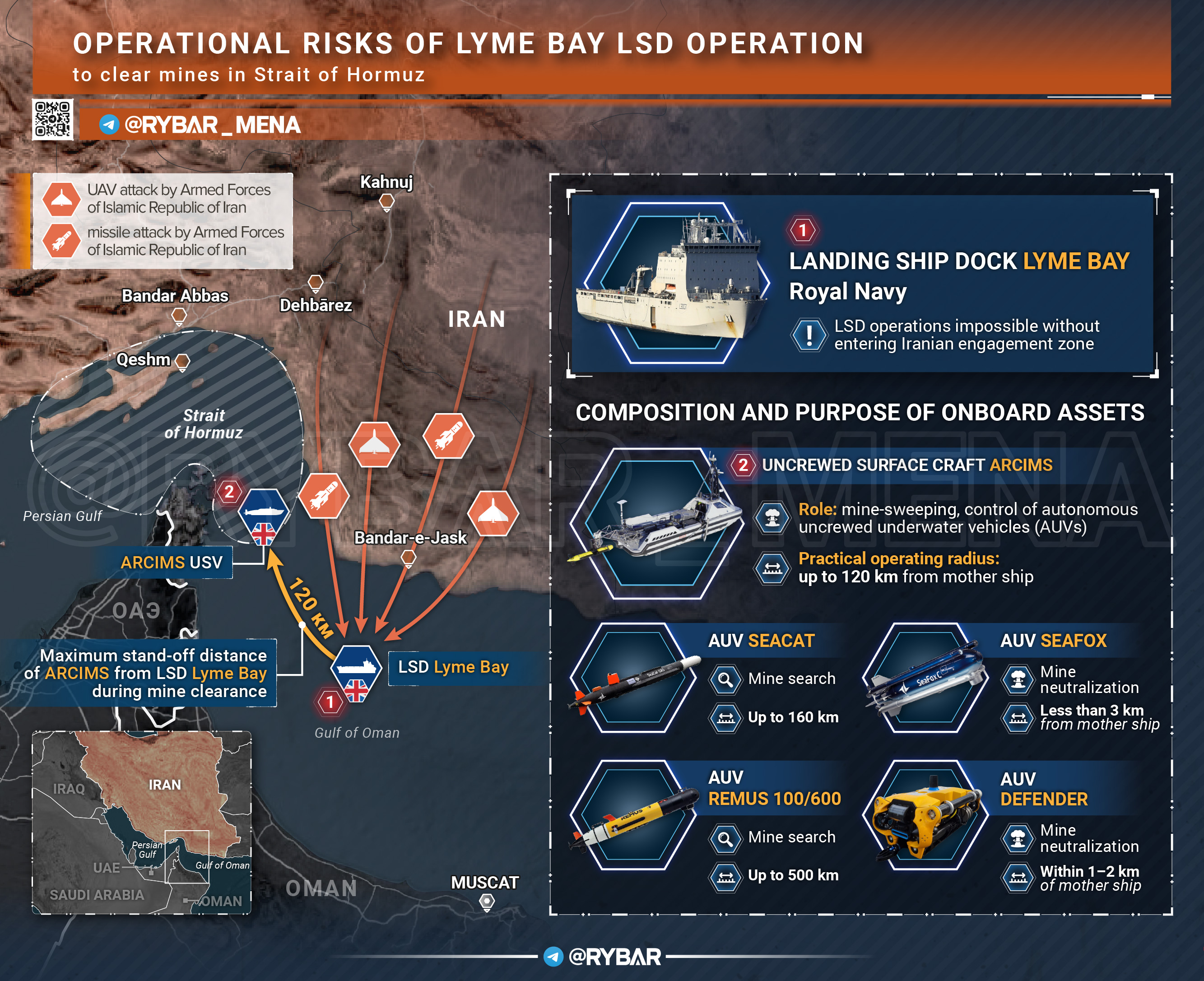
Heavy artillery is being deployed to combat Iranian mines in Hormuz: the Royal Navy's landing dock RFA Lyme Bay, modernized specifically for mine countermeasures operations, is reportedly heading to the Strait.
The ship's unique feature is that unmanned systems, both surface and underwater, carry out the most dangerous operations. Moreover, some of them operate autonomously, increasing the threat detection range.
🔻What's on board?
▪️ARCIMS unmanned boats: These carry autonomous underwater drones (SeaCat, SeaFox, and REMUS 100/600), which, in turn, detect and destroy mines. They can also perform minesweeping using towed equipment. The operational range is approximately 100 km from the carrier or base.
SeaCat — designed for deep-sea reconnaissance and mine detection. Maximum autonomous range is up to 160 km.
SeaFox — kamikaze drones that destroy detected mines with a shaped charge. Maximum range is approximately 3,000 meters via fiber optic cable.
REMUS — time-tested reconnaissance underwater drones used for mine hunting. The number indicates the maximum depth of destruction. The "600" version has an autonomous range of up to 500 km.
Defender — controlled via cable and destroy mines with surface charges within a radius of 1-2 km from the carrier ship.
🖍It would seem that the deal is in the bag, but there's a catch: Lyme Bay's longest-range assets are designed for mine hunting, not mine destruction. Therefore, in practice, the operational range is limited to the ARCIMS+SeaFox combination, which allows for operations at approximately 100 km from the mothership.
And detection isn't so simple either. The "maximum range" assumes that the very expensive device, after its battery life has expired, surfaces for recovery. Therefore, here too, the distance is halved—no one will leave the drones to the Iranians.
🚩This means that, for mine clearance operations in the Strait of Hormuz, Lyme Bay must, under ideal conditions, approach it within 150 kilometers (which the Iranians will be happy about). And since such operating conditions only exist at the testing range, it can be even closer.
📌So far, London has only approved deployment plans, but no decision has been made on the ship's deployment. Therefore, Lyme Bay will likely not reach the Strait anytime soon, and the loud announcements on this topic are only needed as a crisis management measure to keep rising oil prices down.
High-resolution infographics"
🔗 Source:
Please open Telegram to view this post
VIEW IN TELEGRAM
Since the conflict broke out in late February, surging oil prices have hit energy-importing economies hardest, dragging equity benchmarks in South Korea, Japan and India down more than 10%. China, despite being the largest importer, has proved more resilient, with its gauge falling 4.6% over the same period.
As the war shows signs of escalating, the moves suggest Chinese equities may become an increasingly attractive safe haven, thanks to its strength in renewable energy, easing deflation and still-attractive valuations. A growing number of global banks have turned more upbeat, with Goldman Sachs Group Inc. recommended building strategic exposure at current levels while saying the market is better placed than most to withstand oil shocks.
Even before the war, China’s prospects have been improving. Advances in artificial intelligence, a steadier approach to managing US trade tensions, as well as a retreat from regulatory crackdowns have helped rebuild investor confidence. Equities continue to trade at around a 20% discount to the MSCI World Index on earnings-based measures.
In a sign that China has not seen major capital outflows — and may even be seeing inflows — authorities raised the cap on some overseas investments by the most since 2021. Relative stability in the yuan and local markets has given Beijing room to loosen capital controls and promote the currency’s global use.
There is also a second-order effect. Higher energy prices could help pull China out of deflation more quickly, reviving corporate earnings and spurring gains in stocks. While investors still want to see a broader recovery before calling a turnaround, rising prices may prove less of a threat for China compared with the rest of the world.
Please open Telegram to view this post
VIEW IN TELEGRAM
Please open Telegram to view this post
VIEW IN TELEGRAM
Indonesia - February 26 - BEV Trajectory
25.4% BEV
1.4% PHEV
73.2% ICE (of which 12.0%p were HEV)
Trailing 12 months are:
20.1% BEV
1.1% PHEV
78.8% ICE (of which 11.3%p were HEV)
Indonesia has ~600k car registrations/year and in January 2026, ~27% were BEVs or PHEVs. At this rate, Indonesia's car market will be fully electrified by 2030.
The two most sold BEV is the Atto 1 Dynamic Standard Range, aka the 30 kWh LFP Seagull / Dolphin Mini Basis by BYD and the Jaecoo J5 BEV Premium (brand by the manufacturer Chery). Other BEV aren't even close.
China simply dominates.
Please open Telegram to view this post
VIEW IN TELEGRAM
Please open Telegram to view this post
VIEW IN TELEGRAM
Please open Telegram to view this post
VIEW IN TELEGRAM
Malaysian tankers allowed to sail through the Strait of Hormuz won’t be subject to a toll imposed by Iran, according to Transport Minister Anthony Loke.
“The Iranian ambassador has mentioned that no toll is being imposed on Malaysian vessels,” Loke said at an event on Tuesday. “We are a friendly party, we have good diplomatic relationship with the Iranian government.”
On Saturday, Malaysia’s foreign affairs minister said Iran has cleared seven Malaysian tankers to traverse the Strait of Hormuz, which has become a flashpoint of the war in the Middle East. The vessels, which are currently stranded in the vital waterway, include those owned by Malaysian energy giant Petroliam Nasional Bhd., shipping firm MISC Bhd. and Sapura Energy Bhd.
Please open Telegram to view this post
VIEW IN TELEGRAM
archive.ph
Malaysia Says Its Tankers Will Be Exempt from Iran’s Hormuz Toll - Bl…
archived 31 Mar 2026 08:04:46 UTC
Both first-instance decisions and successful appeals are driving the surge as France continues to break records on immigration and residency permits.
Please open Telegram to view this post
VIEW IN TELEGRAM
Please open Telegram to view this post
VIEW IN TELEGRAM
WTI Crude is back over $104 still down from its $106 peak on March 30th.
@CIG_telegram
Please open Telegram to view this post
VIEW IN TELEGRAM
Forwarded from Rerum Novarum // Intel, Breaking News, and Alerts 🇺🇸
Media is too big
VIEW IN TELEGRAM
🇺🇸🇮🇶⚡️- BREAKING: American journalist Shelly Kittleson has been kidnapped by unknown armed men in Baghdad, Iraq.
Footage shows the moment she was abducted.
Footage shows the moment she was abducted.