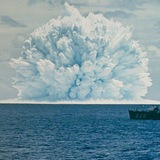
The mysterious massive explosion apparently occurred at a test engine facility inside the highly secretive Israeli Sidot Micha base, located at 31°46'24.08"N 34°53'47.93"E.
A similar explosion took place at the same facility in 2021 during an Israeli rocket engine test.
I wouldn’t rule out the possibility that this was a pre-coordinated or controlled explosion, possibly tied to a solid rocket engine test, especially with Tomer involved.
What doesn’t make sense, though, is why residents in Beit Shemesh weren’t warned beforehand. The lack of warnings beforehand would point to the cause of the explosion being an accident.
Sdot Micha Base, where the explosion occurred, is also considered one of the IDF’s most strategic facilities. Beneath it lies a vast network of hardened underground bunkers and concealed tunnels house much of Israel’s nuclear-capable Jericho ballistic missile arsenal.
In the same area, the Tirosh Strategic Warehousing site sits right next to Sdot Micha base.
This facility functions as an underground weapons storage site. It contains specialized bunkers and tunnel systems assigned for the storage of Israel’s strategic nuclear warheads.
Please open Telegram to view this post
VIEW IN TELEGRAM
Please open Telegram to view this post
VIEW IN TELEGRAM
Forwarded from Geopolitics Watch (Sana'a 🌿)
@GeoPWatch
Please open Telegram to view this post
VIEW IN TELEGRAM
Please open Telegram to view this post
VIEW IN TELEGRAM
Forwarded from Middle East Spectator — MES
—❗️🇺🇸/🇮🇷 BREAKING: U.S. considering making another proposal that would allow Iran to continue enriching uranium up to 3.67%
Until now, the United States had insisted on zero enrichment, even before the war started.
Under this alternative proposal, Iran would get immediate access to $25+ Billion in frozen funds.
NOTE: Iran is still likely to reject this, as it doesn’t address sanctions relief.
@Middle_East_Spectator
Until now, the United States had insisted on zero enrichment, even before the war started.
Under this alternative proposal, Iran would get immediate access to $25+ Billion in frozen funds.
NOTE: Iran is still likely to reject this, as it doesn’t address sanctions relief.
@Middle_East_Spectator
Forwarded from Middle East Spectator — MES
Middle East Spectator — MES
—❗️🇺🇸/🇮🇷 BREAKING: U.S. considering making another proposal that would allow Iran to continue enriching uranium up to 3.67% Until now, the United States had insisted on zero enrichment, even before the war started. Under this alternative proposal, Iran would…
— 🇺🇸/🇮🇷 Laurence Norman, nuclear reporter for WSJ:
‘An alternative version of the U.S. proposal would give Iran access to over $25 Billion dollars and keeping nuclear enrichment capability in tact’
@Middle_East_Spectator
‘An alternative version of the U.S. proposal would give Iran access to over $25 Billion dollars and keeping nuclear enrichment capability in tact’
@Middle_East_Spectator
Forwarded from Middle East Spectator — MES
Ahead of a meeting of finance ministers from the Group of Seven developed economies in Paris on Monday, a senior European official says the situation in the Middle East has highlighted how exposed the interconnected global economy is to external shocks.
“Opening the Strait of Hormuz and bringing the conflict to a lasting end are of the utmost importance in mitigating the impact on the economy,” Eurogroup President Kyriakos Pierrakakis said in a statement.
The Eurogroup is a body that brings together ministers from the euro area and is being represented at the G7 meeting by Pierrakakis, who is also the Greek finance minister. The G7′s core members are the U.S., U.K., Canada, France, Germany, Italy and Japan.
“The European economy has proven resilient in the face of this energy crisis. Yet, the global economy will feel the pressure – even if the conflict is resolved swiftly,” Pierrakakis said.
Long-term borrowing costs in several G7 economies have surged in recent weeks, as investors worry about rising inflation caused by tight energy supplies while the Iran war chokes off oil and gas supplies through the crucial Strait of Hormuz.
U.S. Treasury yields spiked on Friday following a week of messy inflation data and as traders looked to price interest rate policy under new Federal Reserve Chair Kevin Warsh.
The yield on the 30-year bond jumped nearly 11 basis points to yield 5.121%, the highest since May 22, 2025, and nearing the highest since October 2023.
In the U.K., the yield on 30-year government bonds, known as gilts, are trading at their highest since the late 1990s due to a mix of political instability and concerns over rising inflation.
Japan, which is particularly sensitive to inflationary pressure linked to the Iran war, given its status as a major energy importer, has also seen bond yields rise drastically in recent days.
Bond yields and prices move in opposite directions, with traders often commanding higher yields on debt investments when confidence in the government issuing the bonds is shaken.
Please open Telegram to view this post
VIEW IN TELEGRAM
CNBC
G7 finance ministers to meet amid warning of economic consequences of prolonged Strait of Hormuz closure
G7 finance ministers are due to meet in Paris on Monday and Tuesday as long-term borrowing costs surge.
West of Barakah is the border with Saudi Arabia.
@CIG_telegram
Please open Telegram to view this post
VIEW IN TELEGRAM
Please open Telegram to view this post
VIEW IN TELEGRAM
🇨🇳 🇺🇸 📉 Chinese Holdings of U.S. Treasuries have fallen to their lowest level since the Global Financial Crisis
📎 Barchart
📎 Barchart
Please open Telegram to view this post
VIEW IN TELEGRAM