Forwarded from Geopolitics Watch (Keixooki)
Neither the U.S. nor Iran will budge on a diplomatic level.
@GeoPWatch
Please open Telegram to view this post
VIEW IN TELEGRAM
Forwarded from Geopolitics Watch (Keixooki)
Geopolitics Watch
An Iranian Official told Reuters that Iran will not accept excessive U.S. demands and that Iran is prepared to respond forcefully to U.S. strikes, in the region and beyond.
@GeoPWatch
Please open Telegram to view this post
VIEW IN TELEGRAM
Forwarded from Geopolitics Watch (Keixooki)
Iran is an evil nation that has killed many of our people. Soleimani is an example. He’s no longer with us, but they have killed many of our people.
We cannot let them have a nuclear weapon, and we won't.
@GeoPWatch
Please open Telegram to view this post
VIEW IN TELEGRAM
Forwarded from Geopolitics Watch (Keixooki)
We might have to go after Pickaxe, but that's not a big deal. We can do it in literally one hour.
Please open Telegram to view this post
VIEW IN TELEGRAM
/CIG/ Telegram | Counter Intelligence Global
The Kanev Hydroelectric Power Plant in Kanev, Cherkasskaya Oblast, was struck by ~2 Iskander-M ballistic missiles.
The Zmiyovskaya Thermal Power Plant in Slobozhanskoe, Kharkov Oblast, was struck by ~5 Iskander-M ballistic missiles.
The TEC-5 Thermal Power Plant in Kharkov City was struck by ~4 Iskander-M ballistic missiles and ~6 KAB glide-bombs.
The Pridneprovskaya Thermal Power Plant in Dnepropetrovsk was struck by as many as 6 Iskander-M ballistic missiles and 4 Kn-23 ballistic missiles.
The Krivoy Rog Thermal Power Plant in Zelenodolsk, Dnepropetrovsk Oblast, was struck by ~2 Iskander-M ballistic missiles.
The Ladyzhin Thermal Power Plant in Ladyzhin, Vinnitskaya Oblast, was struck by ~4 Zircon hypersonic cruise missiles.
These power plants + additional ones in western Ukraine are expected to be targeted by up to 70 Russian Kh-101 cruise missiles over the next 2 hours.
Please open Telegram to view this post
VIEW IN TELEGRAM
Forwarded from AMK Mapping
In addition to Russia's massive missile and drone attack on energy infrastructure across Ukraine, at least 17 Geran-2 drones attacked the Vylkove and Izmail Ports along the Danube River in southern Odesa Oblast.
Prior to this, the Zatoka Bridge was attacked by 2-3 UMPB-5 jet-powered glide-bombs, 2 Kh-59/69 cruise missiles, and approximately 7 S8000 Banderol cruise missiles.
Prior to this, the Zatoka Bridge was attacked by 2-3 UMPB-5 jet-powered glide-bombs, 2 Kh-59/69 cruise missiles, and approximately 7 S8000 Banderol cruise missiles.
/CIG/ Telegram | Counter Intelligence Global
Azerbaijani leader Ilham Aliyev was a no-show at the Organization of Turkic States (OTS) summit, which concluded on October 30. Aliyev’s snub of Turkish leader Recep Tayyip Erdogan signals that tension between Baku and Ankara is running deeper than previously believed.
A feud between the two long-time allies, whose relations have often been characterised as “one nation, two states,” erupted in mid-October initially revolving around criticism from Turkish public figures of new regulations adopted in Azerbaijan that curtailed religious expression in public schools, effectively banning the wearing of hijabs.
Erdogan on October 25 fired an aide who initiated the hijab kerfuffle, causing many observers to believe that bilateral relations would quickly get back on track. But no.
Aliyev’s decision to skip the summit in Ankara shows the spat is far from over. And where it goes from here is hard to say, given the complexity of the underlying issue dividing the two states.
Aliyev’s absence embarrassed Erdogan, undermining his central message of unity among Turkic states. The summit’s theme was: Turkic Century: Unity in Language, Thought and Action.
In comments to the leaders of other Turkic states at the summit, including the presidents of Kazakhstan, Kyrgyzstan, Uzbekistan and Turkmenistan, Erdogan pointed to the “family photo” of participants taken to commemorate the event, saying it “symbolises both our loyalty to our past and our determination to build our common future together”.
Such rhetoric rang a bit hollow with Aliyev not in the picture. The Azerbaijani delegation was led by Foreign Minister Jeyhun Bayramov, who made no reference to the bilateral spat while praising Turkish hospitality.
Commentaries published in the tightly state-controlled Azerbaijani press indicate that the fulcrum of division between Baku and Ankara is now Israel, not the hijab controversy.
One editorial published on October 29 by Minval indicated that the criticism coming out of Ankara over the hijab issue triggered long-simmering resentment in Azerbaijan connected to Baku’s close strategic relationship with Israel, which supplied military technology, including drones, that helped the Azerbaijani military regain full control of Nagorno-Karabakh in 2023. Turkey has been a frequent and sometimes fierce critic of Israeli policy in Gaza.
“For the past three years, Azerbaijan has repeatedly become a target, with its cooperation with Israel invariably the main focus of the attacks,” the editorial stated. “Baku is essentially being asked to subordinate its foreign policy to foreign perceptions and expectations.”
The editorial, which can be viewed as reflecting the thinking of official Baku, alleged that Azerbaijan had long been subjected to a “torrent of accusations and humiliation” over its strong relationship with Israel, fuelled by Turkish media and social media. It did not mention Erdogan by name but suggested he was responsible for letting the situation get out of hand.
“Official Ankara intervened too late,” it added. “If the necessary steps had been taken in time, if the authorities had not stood by, the situation might not have escalated so far. But now, an unhealthy attitude and an unfavourable atmosphere have developed in Turkey toward Azerbaijan.”
Please open Telegram to view this post
VIEW IN TELEGRAM
bne IntelliNews
Azerbaijan and Turkey: Feud deepens over differences on Israel
Azerbaijani leader Ilham Aliyev was a no-show at the Organization of Turkic States (OTS) summit, which concluded on October 30. Aliyev’s snub of ...
/CIG/ Telegram | Counter Intelligence Global
Russia's military budget is a fifth of America's in dollars, but counted in artillery shells rather than dollars, it buys close to 90% as much.
And the Kremlin is spending big - and more than it can afford. Nominally, Russia's military spending this year is on course to approach RUB17 trillion ($211bn), which is as much as RUB5 trillion ($62bn) more than it initially planned to spend at the start of this year.
While official figures are opaque, the government's budget plan had pencilled in RUB12.1 trillion ($150bn) for "national defence" in 2026, while SIPRI estimated total actual planned military expenditure at RUB14.9 trillion ($185bn), or 6.3% of GDP, in March. Next year's 2027 budget will lift defence spending again to RUB17.1 trillion ($212bn), or a whopping 41% of all spending.
It's a lot of money, but it is still only a fifth of what the $961.6bn the Pentagon requested for FY2026. And if President Donald Trump gets his way, that will rise to $1.5 trillion next year.
However, spend a dollar in Russia and it goes a lot further than one spent in the US as wages and input costs are a lot lower. Consequently, economists prefer to compare PPP (purchase power parity) adjusted spending that takes this difference in price into account.
At the Bank of Russia's official rate of RUB80.56 to the dollar, RUB17 trillion ($211bn) adjusted for PPP Russia's defence spending is worth about $574bn - not 22% of US spending but close to 60% of the US figure - still a big gap, but may be enough to keep Russia in the game if it went to war with the US.
The International Institute for Strategic Studies made the same kind of adjustment in its Military Balance 2025, valuing Russia's 2024 defence spending of RUB13.1 trillion ($163bn) at $462bn in PPP terms - more than the EU and the UK combined that would be in the frontline if war in Europe really does break out.
The story doesn’t stop there as even the PPP adjustment flatters the US. The PPP adjustment is an aggregate adjustment to the value of the currency that takes everything into account, but military production is very specific. The difference between what a dollar spent in the market can buy you in the market is not the same as what it pays for in Russia’s drone factory in the Alabuga Special Economic Zone in Tatarstan or the artillery shell plants in the depths of Siberia.
On the flip side, the US defence sector is bloated, and its products are, in comparative terms, badly overpriced. Instead of comparing dollar-for-adjusted dollars, it makes more sense to compare the cost of production of like-with-like. A dollar of Pentagon money buys fewer shells, tanks and jets than a dollar's worth of rubles does in Russia. Counting the military spending in terms of "artillery shell production units" then Russia's spending on the weapons it actually uses in its war in Ukraine is just under 90% of US spending.
Artillery shell units are the basic comparison as everything that goes into making the Soviet-era standard 152mm shell is Russian: the metal, the gunpowder, the power, the labour. One shell costs an estimated $1000 to make, according to defence publication Militarnyi, whereas the Nato equivalent 155mm shell costs $4000 to make in the US, according to consultancy Bain & Company. The PPP adjustment implies the Russian shell should be about 2.7-times cheaper, but the actual difference is Russian shells are four-times cheaper to make than American shells.
If the war were entirely about shelling the enemy then Russia and the US spending is almost on a par.
Please open Telegram to view this post
VIEW IN TELEGRAM
Please open Telegram to view this post
VIEW IN TELEGRAM
/CIG/ Telegram | Counter Intelligence Global
Hundreds rallied in Somaliland’s capital Hargeisa on October 14, AFP reported, celebrating US President Donald Trump having called the breakaway republic “a totally different country” from Somalia, from which it declared independence 35 years ago.
To date, only one country – Israel, in December 2025 – has recognised Somaliland. Although Washington has given no sign that it is moving to follow suit, officials from the Horn of Africa territory heralded Trump’s characterisation, made at a rally two days earlier, at which he accused Minnesota’s Somali community of widespread fraud.
“I call it Somalia land, not Somaliland, because actually it’s a totally different country,” Trump said, adding: “I think they should change the name immediately.”
Somaliland’s Minister of the Presidency, Khadar Hussein Abdi, was among the first to proclaim it a watershed moment.
“For the first time in history, a sitting U.S. President has publicly acknowledged Somaliland as a country separate from Somalia,” he wrote on X. “We remain hopeful that formal U.S. recognition of the Republic of Somaliland is on the horizon.”
Somaliland’s foreign ministry said it “warmly welcomes US President Donald J. Trump’s acknowledgement of the Republic of Somaliland as a distinct country”, adding that the de facto republic has its own constitution, democratically elected government and foreign relations.
The presidency’s official account was more restrained, saying the remarks “underscore Somaliland’s distinct identity and its separate political reality”.
Israel has been trying to build a military base in Somaliland to counter the Houthis. It was revealed a few months ago Israel has already deployed troops in the region and the military base is likely under construction as of the making of this post but kept hidden from prying eyes. Ansarallah leader, Abdul-Malik al Houthi has threatened to bomb the breakaway region of Somalia if it allows Israel to build a base on its territory. There is also a possibility Israel is using Emirati bases in the region.
Please open Telegram to view this post
VIEW IN TELEGRAM
bne IntelliNews
Trump calls Somaliland ‘a totally different country’ as Hargeisa offers US mining rights in exchange for recognition
Hundreds rallied in Somaliland’s capital Hargeisa on October 14, AFP reported, celebrating US President Donald Trump having called the breakaway ...
Please open Telegram to view this post
VIEW IN TELEGRAM
Forwarded from Tabz - Live News (Tabz)
This media is not supported in your browser
VIEW IN TELEGRAM
The IRGC says the vessels had disabled their navigation and identification systems before hitting the mines. They also noted that all three were abandoned off the strait's southern coast and remain engulfed in flames.
Please open Telegram to view this post
VIEW IN TELEGRAM
/CIG/ Telegram | Counter Intelligence Global
Please open Telegram to view this post
VIEW IN TELEGRAM
Forwarded from Tabz - Live News (Tabz)
The discussions are serious, with Washington and Moscow pushing Beijing to host what would be the first meeting between all three leaders. However, China has not yet decided whether to proceed, and it remains unclear whether negotiations are being conducted jointly or separately.
Russian officials do not expect substantial discussions about Ukraine, believing Beijing prefers to avoid taking a leading role in peace negotiations until an agreement is close.
Please open Telegram to view this post
VIEW IN TELEGRAM
/CIG/ Telegram | Counter Intelligence Global
Media is too big
VIEW IN TELEGRAM
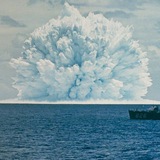
As has been floated in recent days, Netanyahu has been working toward an operation with tactical nuclear missiles against Iran.
This would be different from using a bomb like the ones we saw in Japan, which were designed as strategic weapons to destroy entire cities.
Tactical warheads have a lower destructive yield, usually between 1 and 50 kilotons.
They are designed to eliminate specific military targets on the battlefield, bases, ports, or armored columns, without triggering an instantaneous global apocalypse.
Most of these tactical missiles are, in theory, meant to detonate in the air, hundreds of meters above their targets, avoiding ground contact and leaving radiation that dissipates within weeks in the affected area.
The problem is that the plan reported by Tucker Carlson would involve detonating the Pickaxe Mountain, as Donald Trump also once promised. That would be a radioactive catastrophe of a different order from an airburst hundreds of meters above a region, something that already strikes me as absurd enough.
All of this is terrifying, but the use of a tactical nuclear weapon would mean changing the paradigms on which international relations are built.
The use of tactical missiles and direct attacks against a regional power like Iran would redefine traditional concepts of state sovereignty, respect for borders, and, above all, the logic of global nuclear deterrence.
In international law and relations between states, territorial sovereignty is the fundamental pillar. A direct attack with tactical missiles would transform that dynamic and bring an end to traditional red lines.
It would demonstrate that possessing a robust conventional army or a vast territory no longer prevents invasion or direct bombardment by technologically superior forces.
This would consolidate the idea that states can violate the sovereignty of others on the basis of anticipated threats, a precedent we already live with, but one that would reach another level with nuclear weapons.
The most dangerous shift would occur in how countries view nuclear weapons. Historically, deterrence works on the premise that the cost of attacking a country is too high.
If Iran, a country on the threshold of nuclear development, is attacked in a conventional and tactical manner, the geopolitical message would first and foremost be one of encouragement to proliferate.
This scenario would turn the global board into a far more unpredictable environment, where fear and the rush to acquire weapons of mass destruction would replace diplomacy and economic containment.
Please open Telegram to view this post
VIEW IN TELEGRAM