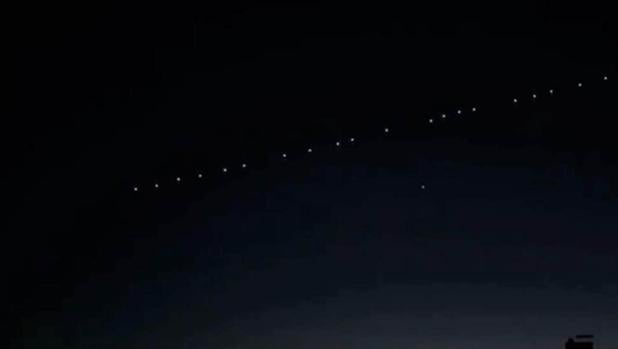
Noticias #eXplora <a href="https://static1.abc.es/media/ciencia/2020/04/21/spacex-starlink-internet-satellites-ufo-kkB--620x349@abc.jpg">Media</a>Ha vuelto a ocurrir. En diferentes partes del mundo, muchas personas observaban una especie de «tren» de luces surcar el cielo. En la era en la que cualquiera tiene cámara en el móvil, las imágenes no dejaron de propagarse por las redes sociales. Las teorías también se multiplicaron: ¿lluvia de estrellas inusual? ¿pruebas de algún ejército? ¿extraterrestres? La solución está alejada de todas ellas: un nuevo «batallón» del ejército llamado Starlink que SpaceX, la compañía del siempre polémico Elon Musk propone poner en órbita para tener su propia red de internet. Desde los cielos de Inglaterra a los de Estados Unidos, varios usuarios de redes sociales han reportado desde el domingo estas llamativas luminarias. Es una de las nuevas remesas con medio centenar de estos satélites que pesan alrededor de los 220 kilos cada uno, se lanzaron a bordo de un Falcon 9 (ideado también por SpaceX) un cohete reutilizable que conseguía volver a tierra y aterrizar con éxito después de su cometido. A partir de ahí, los satélites utilizarán sus propulsores para llegar hasta las órbitas previstas e «ingresar en sus filas». Hasta ese momento, serán visibles en el cielo, en una suerte de «tren estelar» que se irá alejando cada vez más hasta desaparecer (a simple vista).<blockquote class="twitter-tweet"><p lang="en" dir="ltr">Short <a href="https://twitter.com/hashtag/timelapse?src=hash&ref_src=twsrc%5Etfw">#timelapse</a> of the stars around Arcturus in Boötes last night - plenty of satellites visible flashing past as well as some <a href="https://twitter.com/hashtag/starlinksatellites?src=hash&ref_src=twsrc%5Etfw">#starlinksatellites</a>. Looking forward to watching the <a href="https://twitter.com/hashtag/Lyrids?src=hash&ref_src=twsrc%5Etfw">#Lyrids</a> peak this evening <a href="https://twitter.com/hashtag/astronomy?src=hash&ref_src=twsrc%5Etfw">#astronomy</a> <a href="https://twitter.com/hashtag/SpaceHour?src=hash&ref_src=twsrc%5Etfw">#SpaceHour</a> <a href="https://twitter.com/hashtag/stargazing?src=hash&ref_src=twsrc%5Etfw">#stargazing</a> <a href="https://twitter.com/hashtag/Starlink?src=hash&ref_src=twsrc%5Etfw">#Starlink</a> <a href="https://twitter.com/hashtag/stars?src=hash&ref_src=twsrc%5Etfw">#stars</a> <a href="https://t.co/Z17yReocs9">pic.twitter.com/Z17yReocs9</a></p>— Steve Brown - astronomer ✨ (@sjb_astro) <a href="https://twitter.com/sjb_astro/status/1252564907603693568?ref_src=twsrc%5Etfw">April 21, 2020</a></blockquote> <script async src="https://platform.twitter.com/widgets.js" charset="utf-8"></script> <blockquote class="twitter-tweet"><p lang="en" dir="ltr">Two nights ago I was able to see 19 satellites from <a href="https://twitter.com/hashtag/starlink?src=hash&ref_src=twsrc%5Etfw">#starlink</a> <br>Due to the current quarantine and the fact that the air quality is good and the skies are clearer, I was able to see a total of 49 satellites that night in less then 30 minutes. <a href="https://twitter.com/hashtag/satellites?src=hash&ref_src=twsrc%5Etfw">#satellites</a> <a href="https://twitter.com/hashtag/space?src=hash&ref_src=twsrc%5Etfw">#space</a> <a href="https://twitter.com/hashtag/spacex?src=hash&ref_src=twsrc%5Etfw">#spacex</a> <a href="https://twitter.com/hashtag/stem?src=hash&ref_src=twsrc%5Etfw">#stem</a> <a href="https://t.co/du6IjZJYZd">pic.twitter.com/du6IjZJYZd</a></p>— AstroTurin (@AstroTurin) <a href="https://twitter.com/AstroTurin/status/1252443274926682112?ref_src=twsrc%5Etfw">April 21, 2020</a></blockquote> <script async src="https://platform.twitter.com/widgets.js" charset="utf-8"></script> <blockquote class="twitter-tweet"><p lang="en" dir="ltr">I walked to the north shore of Utah Lake in the morning twilight, hoping to get some nice photos and take my mind off the pandemic. Instead I got this…