About 🇨🇱 #Chile's Protests | The Vanguardia, the Far-right "alliance":
With southern Chile being seized by heavy clashes between Mapuche separatist/far-left militants versus government forces and large centers being taken over by Massive Riots & lack of govt action chileans found themselves facing a paradigm:
— React or just let themselves being coerced by Rioters & MIlitants
This reaction ultimately resulted in what is now called "Vanguardia", an alliance of several right-wing groups of the most varied, who originally appeared as "Peace Enforcers" and protectors of protests by the Chilean Right against the liberal-globalist govt of Sebastián Piñera
Vanguardia in general includes:
— 🇨🇱☠️ The ATP Ultra-Nationalists
— 🇨🇱🚁🐍 Pinochetist/NatCap Cliques
— 🇨🇱🟨🐍🟨 Anarcho-Capitalists of "Revolutionary Capitalism" movement
— 🇨🇱🦅 José Antonio Kast's Yellow Vests Boomers
— Several smaller Nationalist cliques
With southern Chile being seized by heavy clashes between Mapuche separatist/far-left militants versus government forces and large centers being taken over by Massive Riots & lack of govt action chileans found themselves facing a paradigm:
— React or just let themselves being coerced by Rioters & MIlitants
This reaction ultimately resulted in what is now called "Vanguardia", an alliance of several right-wing groups of the most varied, who originally appeared as "Peace Enforcers" and protectors of protests by the Chilean Right against the liberal-globalist govt of Sebastián Piñera
Vanguardia in general includes:
— 🇨🇱☠️ The ATP Ultra-Nationalists
— 🇨🇱🚁🐍 Pinochetist/NatCap Cliques
— 🇨🇱🟨🐍🟨 Anarcho-Capitalists of "Revolutionary Capitalism" movement
— 🇨🇱🦅 José Antonio Kast's Yellow Vests Boomers
— Several smaller Nationalist cliques
Forwarded from Blood Meridian
🇧🇴🇦🇷🇨🇱 Bolivia is open to signing agreements with Argentina and Chile to influence lithium prices
Bolivia is seeking partnerships with Argentina and Chile to impact the global price of lithium as a sort of lithium OPEC.
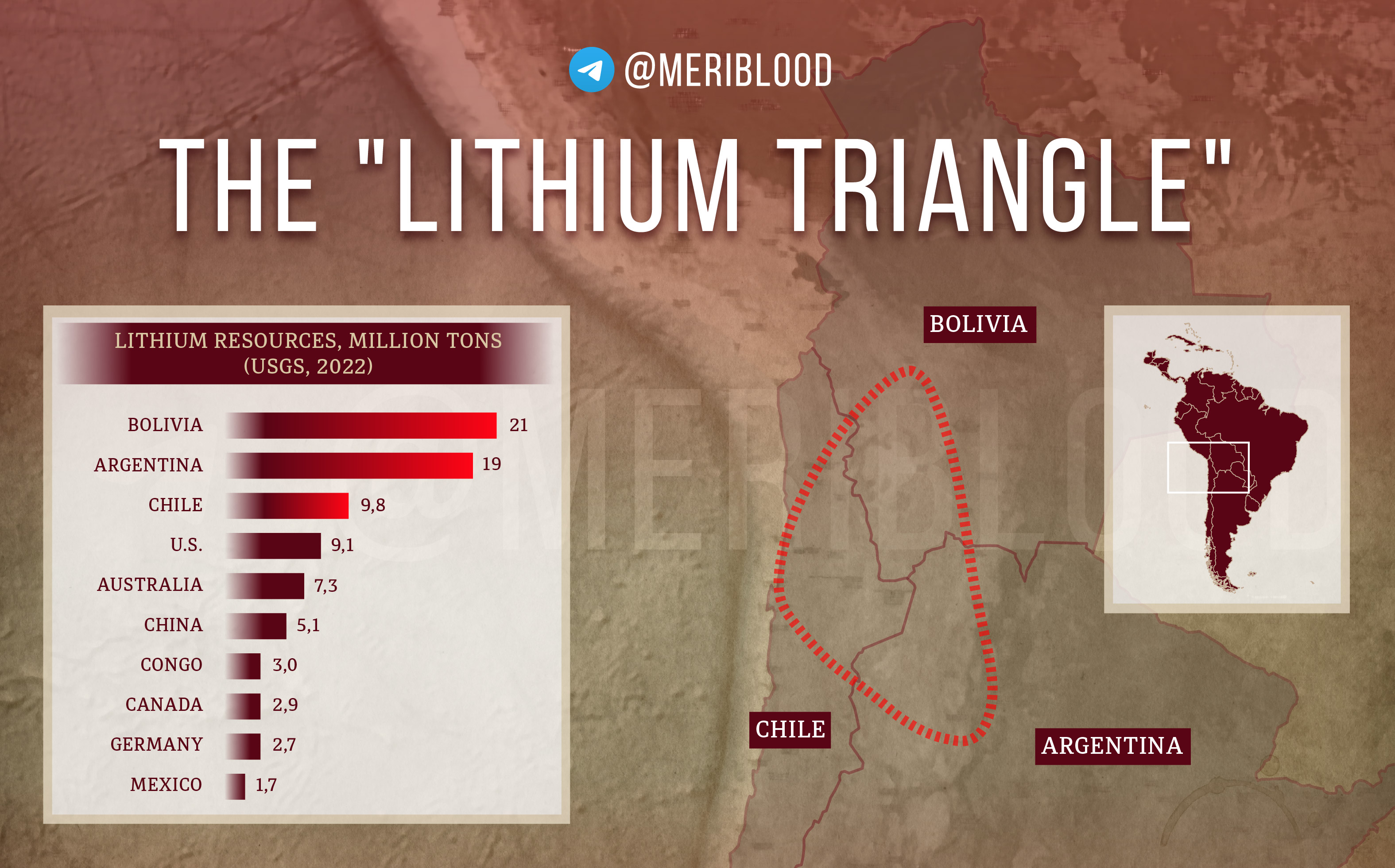
Together, these countries possess the largest lithium reserves worldwide, with Bolivia holding 21 million tons, Argentina 19 million tons, and Chile 9 million tons.
Bolivia has established agreements with Argentina’s Y-TEC and its own YLB to exchange knowledge in battery manufacturing. While there are no formal agreements with Chile, Bolivia hopes to collaborate in the future to influence international lithium prices jointly.
Bolivia has signed investment deals with Russian and Chinese companies to construct lithium extraction and production plants.
Their goal is to produce 100,000 tons of lithium by 2025 and become a significant supplier in the international market.
🔎 Source
#Bolivia #Argentina #Chile
☠️ Blood Meridian
Bolivia is seeking partnerships with Argentina and Chile to impact the global price of lithium as a sort of lithium OPEC.
Together, these countries possess the largest lithium reserves worldwide, with Bolivia holding 21 million tons, Argentina 19 million tons, and Chile 9 million tons.
Bolivia has established agreements with Argentina’s Y-TEC and its own YLB to exchange knowledge in battery manufacturing. While there are no formal agreements with Chile, Bolivia hopes to collaborate in the future to influence international lithium prices jointly.
Bolivia has signed investment deals with Russian and Chinese companies to construct lithium extraction and production plants.
Their goal is to produce 100,000 tons of lithium by 2025 and become a significant supplier in the international market.
🔎 Source
#Bolivia #Argentina #Chile
☠️ Blood Meridian
Forwarded from Blood Meridian
🌎 🔨LatAm in the world's race for lithium: Part 1. Resources
Chile, Argentina and Bolivia alone hold 2/3 of the world's lithium reserves. Will such an advantage help these three countries succeed in a world where demand for lithium is soaring?
🔻The 'Lithium Triangle'
The so-called 'lithium triangle' is an arid region with expansive salt flats, shared between Chile, Argentina and Bolivia. According to estimates, this region holds 54% of the world’s lithium resources. The lithium deposits are found underneath the salt flats (contrary to Australia, which mines directly from hard rock deposits).
Bolivia is home to 21 million tons of lithium, followed by Argentina with 19.3 million and Chile with 9.6 million. These numbers are still subject to change, as active exploration leads to an increase in known resources. Identified global lithium resources rose from 53 million tons in 2018 to 89 million tons in 2022, according to the USGS.
🔻Three countries - three approaches
🇨🇱 Chile has transformed the majority of its available resources into economically viable reserves available for commercial production. Having the lowest deposits (out of the three countries), it managed to become the world’s second-largest commercial producer after Australia. The Atacama salt flat has the highest-quality, proven reserves with a low cost of production.
Things might soon change, though, as the Chilean government announced in April it will nationalize the country's lithium, requiring the state to control 51% of future ventures. Foreign lithium miners, such as Chinese SQM now must renegotiate its contract under the new rules. The Chilean Copper Commission already warns Argentina might overtake Chile as the 2nd world lithium producer by 2035, as Chile's market share is expected to decline.
🇧🇴 Bolivia has struggled to transform its lithium resources into commercially viable reserves, due in large part to the poor investment climate and the country’s political instability. The country nationalized its lithium reserves back in 2008 and missed out on foreign investment opportunities in the following decade. Having recently signed deals with China and Russia, Bolivia hopes to quickly reach high production levels in the coming years.
🇦🇷 Argentina has created a more favorable investment climate, as it asks for only 3% royalty (lower than Chile, which imposes a progressive royalty that can reach up to 40%). Since 2020, over $4 billion in investments have been announced, with dozens of private sector projects now in the pipeline. Most of these investments come from Chinese companies.
The three countries are in talks about a possible regional alliance on lithium - "a kind of lithium OPEC," as Bolivian President Luis Arce puts it.
🔻North America
🇺🇸 North America is also rich in lithium. The U.S. ranks 4th in total resources (9,1 million tons), but the only active lithium mine is in the state of Nevada, producing just 1% of global lithium.
🇲🇽 Mexico, which also holds some lithium reserves, nationalized its lithium last year and has since announced that only joint ventures with majority state control could exploit the mineral. Those companies that started lithium exploration before the nationalization process began will be able to continue mining under the previous terms.
Despite holding the largest lithium reserves, Latin American countries are lagging behind when it comes to lithium production and processing. So, which countries are actually taking advantage of the growing lithium market?
🔻🔻🔻
Part 2
#analysis #LatAm #lithium #resources #Chile #Argentina #Bolivia #US #Mexico
☠️ Blood Meridian
Chile, Argentina and Bolivia alone hold 2/3 of the world's lithium reserves. Will such an advantage help these three countries succeed in a world where demand for lithium is soaring?
🔻The 'Lithium Triangle'
The so-called 'lithium triangle' is an arid region with expansive salt flats, shared between Chile, Argentina and Bolivia. According to estimates, this region holds 54% of the world’s lithium resources. The lithium deposits are found underneath the salt flats (contrary to Australia, which mines directly from hard rock deposits).
Bolivia is home to 21 million tons of lithium, followed by Argentina with 19.3 million and Chile with 9.6 million. These numbers are still subject to change, as active exploration leads to an increase in known resources. Identified global lithium resources rose from 53 million tons in 2018 to 89 million tons in 2022, according to the USGS.
🔻Three countries - three approaches
🇨🇱 Chile has transformed the majority of its available resources into economically viable reserves available for commercial production. Having the lowest deposits (out of the three countries), it managed to become the world’s second-largest commercial producer after Australia. The Atacama salt flat has the highest-quality, proven reserves with a low cost of production.
Things might soon change, though, as the Chilean government announced in April it will nationalize the country's lithium, requiring the state to control 51% of future ventures. Foreign lithium miners, such as Chinese SQM now must renegotiate its contract under the new rules. The Chilean Copper Commission already warns Argentina might overtake Chile as the 2nd world lithium producer by 2035, as Chile's market share is expected to decline.
🇧🇴 Bolivia has struggled to transform its lithium resources into commercially viable reserves, due in large part to the poor investment climate and the country’s political instability. The country nationalized its lithium reserves back in 2008 and missed out on foreign investment opportunities in the following decade. Having recently signed deals with China and Russia, Bolivia hopes to quickly reach high production levels in the coming years.
🇦🇷 Argentina has created a more favorable investment climate, as it asks for only 3% royalty (lower than Chile, which imposes a progressive royalty that can reach up to 40%). Since 2020, over $4 billion in investments have been announced, with dozens of private sector projects now in the pipeline. Most of these investments come from Chinese companies.
The three countries are in talks about a possible regional alliance on lithium - "a kind of lithium OPEC," as Bolivian President Luis Arce puts it.
🔻North America
🇺🇸 North America is also rich in lithium. The U.S. ranks 4th in total resources (9,1 million tons), but the only active lithium mine is in the state of Nevada, producing just 1% of global lithium.
🇲🇽 Mexico, which also holds some lithium reserves, nationalized its lithium last year and has since announced that only joint ventures with majority state control could exploit the mineral. Those companies that started lithium exploration before the nationalization process began will be able to continue mining under the previous terms.
Despite holding the largest lithium reserves, Latin American countries are lagging behind when it comes to lithium production and processing. So, which countries are actually taking advantage of the growing lithium market?
🔻🔻🔻
Part 2
#analysis #LatAm #lithium #resources #Chile #Argentina #Bolivia #US #Mexico
☠️ Blood Meridian
Forwarded from Blood Meridian
🌎 🔨LatAm in the world's race for lithium: Part 2. Production
🔻Producers
🇦🇺 Australia leads in lithium production by a wide margin, having produced 61,000 tons last year. Australia's lithium production is expected to grow at a rate of 14.2 percent and reach 116,240 tons in 2026 as mines expand. Most of the country’s lithium supply is exported to China as spodumene.
🇨🇱 Chile, the world's second largest lithium producer (39,000 tons per year), focuses not so much on the domestic processing of lithium, but rather on exporting raw materials to, primarily, South Korea, Japan, China and the EU. The recent increase in exports from Chile has predominantly been associated with lithium carbonates, which are relatively unrefined.
🇨🇳 China comes in third, producing 19,000 tons per year. While production in China is comparatively low, China imports lithium in large quantities and dominates lithium refining and battery production.
🔻China's interest
China's rapid increase in the manufacturing of goods and components means that its demand for lithium is growing at 10% a year. China has over half of the world's lithium refining capacity but has to rely on imports for about two-thirds of the raw material.
Chinese companies are now increasing their investments in the "lithium triangle." China’s Ganfeng Lithium, for example, is the majority stakeholder in Argentina’s Caucharí-Olaroz operation.
Similarly, in Chile, China’s Tianqi Lithium became the second-largest shareholder in SQM, holding 23.8 percent of shares. The Chinese companies Ganfeng Lithium and Tianqi Lithium now represent two of the top three lithium mining companies in the world.
🔻EU investments
The EU has consistently shown interest in South American lithium. In January, Scholz toured Latin America, and lithium mining was not the last thing on the agenda. At the EU-CELAC summit, EU countries announced €45bn ($49,5bn) in investments in the region, some of which are aimed at resource extraction under the guise of green initiatives.
🔻Rare earth elements industry
The US and China have split roles in the rare earth elements (REE) market and have maintained them, at least until recently. China has been developing its own resources and buying cheap raw materials from other countries, Latin America included. China has taken a large share of the REE processing market and has established production of batteries and components needed for green industries, but has not fully engaged in high-tech manufacturing.
The US and other developed countries have taken over the production of the final high-tech products of the green industry. At the same time, the US did not prevent China from increasing its presence in Latin American countries and buying cheap raw materials, as it was beneficial to both countries.
Now the REE market is changing. The US and the EU are interested in negotiating cheap raw material supplies and investing in processing facilities in Latin America, not only to reduce dependence on China but also to get their share of profits.
China is trying to develop its own high-tech manufacturing. In many areas, China will have to start from scratch because developed countries are reluctant to share the technology.
🔻"Lithium triangle" role
In this context, the "lithium triangle" countries don't care who they sell their lithium to: China, the US or the EU. Argentina, Chile and Bolivia are trying to capitalize on the growth of the lithium industry and develop domestic industrial infrastructure. However, these countries will not be able to see the same profits as the developed countries that produce the final high-tech product.
At the same time, by allowing investors into their markets, these countries give up some control. It will be easier for investors to promote their interests and dictate their terms when countries such as Bolivia, Chile and Argentina depend on resource extraction for a significant part of their budget.
🔻🔻🔻
Part 1
#analysis #LatAm #lithium #resources #Chile #Argentina #Bolivia #US #China
☠️ Blood Meridian
🔻Producers
🇦🇺 Australia leads in lithium production by a wide margin, having produced 61,000 tons last year. Australia's lithium production is expected to grow at a rate of 14.2 percent and reach 116,240 tons in 2026 as mines expand. Most of the country’s lithium supply is exported to China as spodumene.
🇨🇱 Chile, the world's second largest lithium producer (39,000 tons per year), focuses not so much on the domestic processing of lithium, but rather on exporting raw materials to, primarily, South Korea, Japan, China and the EU. The recent increase in exports from Chile has predominantly been associated with lithium carbonates, which are relatively unrefined.
🇨🇳 China comes in third, producing 19,000 tons per year. While production in China is comparatively low, China imports lithium in large quantities and dominates lithium refining and battery production.
🔻China's interest
China's rapid increase in the manufacturing of goods and components means that its demand for lithium is growing at 10% a year. China has over half of the world's lithium refining capacity but has to rely on imports for about two-thirds of the raw material.
Chinese companies are now increasing their investments in the "lithium triangle." China’s Ganfeng Lithium, for example, is the majority stakeholder in Argentina’s Caucharí-Olaroz operation.
Similarly, in Chile, China’s Tianqi Lithium became the second-largest shareholder in SQM, holding 23.8 percent of shares. The Chinese companies Ganfeng Lithium and Tianqi Lithium now represent two of the top three lithium mining companies in the world.
🔻EU investments
The EU has consistently shown interest in South American lithium. In January, Scholz toured Latin America, and lithium mining was not the last thing on the agenda. At the EU-CELAC summit, EU countries announced €45bn ($49,5bn) in investments in the region, some of which are aimed at resource extraction under the guise of green initiatives.
🔻Rare earth elements industry
The US and China have split roles in the rare earth elements (REE) market and have maintained them, at least until recently. China has been developing its own resources and buying cheap raw materials from other countries, Latin America included. China has taken a large share of the REE processing market and has established production of batteries and components needed for green industries, but has not fully engaged in high-tech manufacturing.
The US and other developed countries have taken over the production of the final high-tech products of the green industry. At the same time, the US did not prevent China from increasing its presence in Latin American countries and buying cheap raw materials, as it was beneficial to both countries.
Now the REE market is changing. The US and the EU are interested in negotiating cheap raw material supplies and investing in processing facilities in Latin America, not only to reduce dependence on China but also to get their share of profits.
China is trying to develop its own high-tech manufacturing. In many areas, China will have to start from scratch because developed countries are reluctant to share the technology.
🔻"Lithium triangle" role
In this context, the "lithium triangle" countries don't care who they sell their lithium to: China, the US or the EU. Argentina, Chile and Bolivia are trying to capitalize on the growth of the lithium industry and develop domestic industrial infrastructure. However, these countries will not be able to see the same profits as the developed countries that produce the final high-tech product.
At the same time, by allowing investors into their markets, these countries give up some control. It will be easier for investors to promote their interests and dictate their terms when countries such as Bolivia, Chile and Argentina depend on resource extraction for a significant part of their budget.
🔻🔻🔻
Part 1
#analysis #LatAm #lithium #resources #Chile #Argentina #Bolivia #US #China
☠️ Blood Meridian

Forwarded from Blood Meridian
🌎 🔨LatAm in the world's race for lithium: Part 1. Resources
Chile, Argentina and Bolivia alone hold 2/3 of the world's lithium reserves. Will such an advantage help these three countries succeed in a world where demand for lithium is soaring?
🔻The 'Lithium Triangle'
The so-called 'lithium triangle' is an arid region with expansive salt flats, shared between Chile, Argentina and Bolivia. According to estimates, this region holds 54% of the world’s lithium resources. The lithium deposits are found underneath the salt flats (contrary to Australia, which mines directly from hard rock deposits).
Bolivia is home to 21 million tons of lithium, followed by Argentina with 19.3 million and Chile with 9.6 million. These numbers are still subject to change, as active exploration leads to an increase in known resources. Identified global lithium resources rose from 53 million tons in 2018 to 89 million tons in 2022, according to the USGS.
🔻Three countries - three approaches
🇨🇱 Chile has transformed the majority of its available resources into economically viable reserves available for commercial production. Having the lowest deposits (out of the three countries), it managed to become the world’s second-largest commercial producer after Australia. The Atacama salt flat has the highest-quality, proven reserves with a low cost of production.
Things might soon change, though, as the Chilean government announced in April it will nationalize the country's lithium, requiring the state to control 51% of future ventures. Foreign lithium miners, such as Chinese SQM now must renegotiate its contract under the new rules. The Chilean Copper Commission already warns Argentina might overtake Chile as the 2nd world lithium producer by 2035, as Chile's market share is expected to decline.
🇧🇴 Bolivia has struggled to transform its lithium resources into commercially viable reserves, due in large part to the poor investment climate and the country’s political instability. The country nationalized its lithium reserves back in 2008 and missed out on foreign investment opportunities in the following decade. Having recently signed deals with China and Russia, Bolivia hopes to quickly reach high production levels in the coming years.
🇦🇷 Argentina has created a more favorable investment climate, as it asks for only 3% royalty (lower than Chile, which imposes a progressive royalty that can reach up to 40%). Since 2020, over $4 billion in investments have been announced, with dozens of private sector projects now in the pipeline. Most of these investments come from Chinese companies.
The three countries are in talks about a possible regional alliance on lithium - "a kind of lithium OPEC," as Bolivian President Luis Arce puts it.
🔻North America
🇺🇸 North America is also rich in lithium. The U.S. ranks 4th in total resources (9,1 million tons), but the only active lithium mine is in the state of Nevada, producing just 1% of global lithium.
🇲🇽 Mexico, which also holds some lithium reserves, nationalized its lithium last year and has since announced that only joint ventures with majority state control could exploit the mineral. Those companies that started lithium exploration before the nationalization process began will be able to continue mining under the previous terms.
Despite holding the largest lithium reserves, Latin American countries are lagging behind when it comes to lithium production and processing. So, which countries are actually taking advantage of the growing lithium market?
🔻🔻🔻
Part 2
#analysis #LatAm #lithium #resources #Chile #Argentina #Bolivia #US #Mexico
☠️ Blood Meridian
Chile, Argentina and Bolivia alone hold 2/3 of the world's lithium reserves. Will such an advantage help these three countries succeed in a world where demand for lithium is soaring?
🔻The 'Lithium Triangle'
The so-called 'lithium triangle' is an arid region with expansive salt flats, shared between Chile, Argentina and Bolivia. According to estimates, this region holds 54% of the world’s lithium resources. The lithium deposits are found underneath the salt flats (contrary to Australia, which mines directly from hard rock deposits).
Bolivia is home to 21 million tons of lithium, followed by Argentina with 19.3 million and Chile with 9.6 million. These numbers are still subject to change, as active exploration leads to an increase in known resources. Identified global lithium resources rose from 53 million tons in 2018 to 89 million tons in 2022, according to the USGS.
🔻Three countries - three approaches
🇨🇱 Chile has transformed the majority of its available resources into economically viable reserves available for commercial production. Having the lowest deposits (out of the three countries), it managed to become the world’s second-largest commercial producer after Australia. The Atacama salt flat has the highest-quality, proven reserves with a low cost of production.
Things might soon change, though, as the Chilean government announced in April it will nationalize the country's lithium, requiring the state to control 51% of future ventures. Foreign lithium miners, such as Chinese SQM now must renegotiate its contract under the new rules. The Chilean Copper Commission already warns Argentina might overtake Chile as the 2nd world lithium producer by 2035, as Chile's market share is expected to decline.
🇧🇴 Bolivia has struggled to transform its lithium resources into commercially viable reserves, due in large part to the poor investment climate and the country’s political instability. The country nationalized its lithium reserves back in 2008 and missed out on foreign investment opportunities in the following decade. Having recently signed deals with China and Russia, Bolivia hopes to quickly reach high production levels in the coming years.
🇦🇷 Argentina has created a more favorable investment climate, as it asks for only 3% royalty (lower than Chile, which imposes a progressive royalty that can reach up to 40%). Since 2020, over $4 billion in investments have been announced, with dozens of private sector projects now in the pipeline. Most of these investments come from Chinese companies.
The three countries are in talks about a possible regional alliance on lithium - "a kind of lithium OPEC," as Bolivian President Luis Arce puts it.
🔻North America
🇺🇸 North America is also rich in lithium. The U.S. ranks 4th in total resources (9,1 million tons), but the only active lithium mine is in the state of Nevada, producing just 1% of global lithium.
🇲🇽 Mexico, which also holds some lithium reserves, nationalized its lithium last year and has since announced that only joint ventures with majority state control could exploit the mineral. Those companies that started lithium exploration before the nationalization process began will be able to continue mining under the previous terms.
Despite holding the largest lithium reserves, Latin American countries are lagging behind when it comes to lithium production and processing. So, which countries are actually taking advantage of the growing lithium market?
🔻🔻🔻
Part 2
#analysis #LatAm #lithium #resources #Chile #Argentina #Bolivia #US #Mexico
☠️ Blood Meridian
Forwarded from Blood Meridian
🌎 🔨LatAm in the world's race for lithium: Part 2. Production
🔻Producers
🇦🇺 Australia leads in lithium production by a wide margin, having produced 61,000 tons last year. Australia's lithium production is expected to grow at a rate of 14.2 percent and reach 116,240 tons in 2026 as mines expand. Most of the country’s lithium supply is exported to China as spodumene.
🇨🇱 Chile, the world's second largest lithium producer (39,000 tons per year), focuses not so much on the domestic processing of lithium, but rather on exporting raw materials to, primarily, South Korea, Japan, China and the EU. The recent increase in exports from Chile has predominantly been associated with lithium carbonates, which are relatively unrefined.
🇨🇳 China comes in third, producing 19,000 tons per year. While production in China is comparatively low, China imports lithium in large quantities and dominates lithium refining and battery production.
🔻China's interest
China's rapid increase in the manufacturing of goods and components means that its demand for lithium is growing at 10% a year. China has over half of the world's lithium refining capacity but has to rely on imports for about two-thirds of the raw material.
Chinese companies are now increasing their investments in the "lithium triangle." China’s Ganfeng Lithium, for example, is the majority stakeholder in Argentina’s Caucharí-Olaroz operation.
Similarly, in Chile, China’s Tianqi Lithium became the second-largest shareholder in SQM, holding 23.8 percent of shares. The Chinese companies Ganfeng Lithium and Tianqi Lithium now represent two of the top three lithium mining companies in the world.
🔻EU investments
The EU has consistently shown interest in South American lithium. In January, Scholz toured Latin America, and lithium mining was not the last thing on the agenda. At the EU-CELAC summit, EU countries announced €45bn ($49,5bn) in investments in the region, some of which are aimed at resource extraction under the guise of green initiatives.
🔻Rare earth elements industry
The US and China have split roles in the rare earth elements (REE) market and have maintained them, at least until recently. China has been developing its own resources and buying cheap raw materials from other countries, Latin America included. China has taken a large share of the REE processing market and has established production of batteries and components needed for green industries, but has not fully engaged in high-tech manufacturing.
The US and other developed countries have taken over the production of the final high-tech products of the green industry. At the same time, the US did not prevent China from increasing its presence in Latin American countries and buying cheap raw materials, as it was beneficial to both countries.
Now the REE market is changing. The US and the EU are interested in negotiating cheap raw material supplies and investing in processing facilities in Latin America, not only to reduce dependence on China but also to get their share of profits.
China is trying to develop its own high-tech manufacturing. In many areas, China will have to start from scratch because developed countries are reluctant to share the technology.
🔻"Lithium triangle" role
In this context, the "lithium triangle" countries don't care who they sell their lithium to: China, the US or the EU. Argentina, Chile and Bolivia are trying to capitalize on the growth of the lithium industry and develop domestic industrial infrastructure. However, these countries will not be able to see the same profits as the developed countries that produce the final high-tech product.
At the same time, by allowing investors into their markets, these countries give up some control. It will be easier for investors to promote their interests and dictate their terms when countries such as Bolivia, Chile and Argentina depend on resource extraction for a significant part of their budget.
🔻🔻🔻
Part 1
#analysis #LatAm #lithium #resources #Chile #Argentina #Bolivia #US #China
☠️ Blood Meridian
🔻Producers
🇦🇺 Australia leads in lithium production by a wide margin, having produced 61,000 tons last year. Australia's lithium production is expected to grow at a rate of 14.2 percent and reach 116,240 tons in 2026 as mines expand. Most of the country’s lithium supply is exported to China as spodumene.
🇨🇱 Chile, the world's second largest lithium producer (39,000 tons per year), focuses not so much on the domestic processing of lithium, but rather on exporting raw materials to, primarily, South Korea, Japan, China and the EU. The recent increase in exports from Chile has predominantly been associated with lithium carbonates, which are relatively unrefined.
🇨🇳 China comes in third, producing 19,000 tons per year. While production in China is comparatively low, China imports lithium in large quantities and dominates lithium refining and battery production.
🔻China's interest
China's rapid increase in the manufacturing of goods and components means that its demand for lithium is growing at 10% a year. China has over half of the world's lithium refining capacity but has to rely on imports for about two-thirds of the raw material.
Chinese companies are now increasing their investments in the "lithium triangle." China’s Ganfeng Lithium, for example, is the majority stakeholder in Argentina’s Caucharí-Olaroz operation.
Similarly, in Chile, China’s Tianqi Lithium became the second-largest shareholder in SQM, holding 23.8 percent of shares. The Chinese companies Ganfeng Lithium and Tianqi Lithium now represent two of the top three lithium mining companies in the world.
🔻EU investments
The EU has consistently shown interest in South American lithium. In January, Scholz toured Latin America, and lithium mining was not the last thing on the agenda. At the EU-CELAC summit, EU countries announced €45bn ($49,5bn) in investments in the region, some of which are aimed at resource extraction under the guise of green initiatives.
🔻Rare earth elements industry
The US and China have split roles in the rare earth elements (REE) market and have maintained them, at least until recently. China has been developing its own resources and buying cheap raw materials from other countries, Latin America included. China has taken a large share of the REE processing market and has established production of batteries and components needed for green industries, but has not fully engaged in high-tech manufacturing.
The US and other developed countries have taken over the production of the final high-tech products of the green industry. At the same time, the US did not prevent China from increasing its presence in Latin American countries and buying cheap raw materials, as it was beneficial to both countries.
Now the REE market is changing. The US and the EU are interested in negotiating cheap raw material supplies and investing in processing facilities in Latin America, not only to reduce dependence on China but also to get their share of profits.
China is trying to develop its own high-tech manufacturing. In many areas, China will have to start from scratch because developed countries are reluctant to share the technology.
🔻"Lithium triangle" role
In this context, the "lithium triangle" countries don't care who they sell their lithium to: China, the US or the EU. Argentina, Chile and Bolivia are trying to capitalize on the growth of the lithium industry and develop domestic industrial infrastructure. However, these countries will not be able to see the same profits as the developed countries that produce the final high-tech product.
At the same time, by allowing investors into their markets, these countries give up some control. It will be easier for investors to promote their interests and dictate their terms when countries such as Bolivia, Chile and Argentina depend on resource extraction for a significant part of their budget.
🔻🔻🔻
Part 1
#analysis #LatAm #lithium #resources #Chile #Argentina #Bolivia #US #China
☠️ Blood Meridian
Forwarded from Blood Meridian
🇵🇪🇨🇱 Peru and Chile urged to speed up copper projects
As copper deposits in Peru and Chile are reaching the end of their useful life, both countries are being urged to unblock new projects to meet global demand and make the most of their potential.
Over 60% of copper projects worldwide facing uncertainty are located in Latin America, most of them in Peru and Chile. These projects are not operating, lack investment decisions or construction has not started.
$123bn in investments must be executed in the next five years to start covering a copper deficit of 9.5Mt projected for 2030.
🔎 Source
#Chile #Peru #resources
☠️ Blood Meridian
As copper deposits in Peru and Chile are reaching the end of their useful life, both countries are being urged to unblock new projects to meet global demand and make the most of their potential.
Over 60% of copper projects worldwide facing uncertainty are located in Latin America, most of them in Peru and Chile. These projects are not operating, lack investment decisions or construction has not started.
$123bn in investments must be executed in the next five years to start covering a copper deficit of 9.5Mt projected for 2030.
🔎 Source
#Chile #Peru #resources
☠️ Blood Meridian
Forwarded from Blood Meridian
🇨🇱Chile will consider 81 lithium projects proposals from private sector
Chilean officials on Tuesday said they will consider 81 proposals for lithium projects across the South American country, putting the country on track to surpass a goal of launching four new projects by the end of 2026.
Chile in April called for proposals in more than two dozen salt flats that contain the battery metal, in line with the government's aims to boost production. It is currently the world's No. 2 producer.
The interested firms are mostly based in Chile, as well as Canada, Australia, Switzerland, the United States, China, Singapore, England, Germany and India. They submitted proposals for 16 salt flats as well as other types of deposits containing lithium.
🔎 Source
#Chile #resources
☠️ Blood Meridian
Chilean officials on Tuesday said they will consider 81 proposals for lithium projects across the South American country, putting the country on track to surpass a goal of launching four new projects by the end of 2026.
Chile in April called for proposals in more than two dozen salt flats that contain the battery metal, in line with the government's aims to boost production. It is currently the world's No. 2 producer.
The interested firms are mostly based in Chile, as well as Canada, Australia, Switzerland, the United States, China, Singapore, England, Germany and India. They submitted proposals for 16 salt flats as well as other types of deposits containing lithium.
🔎 Source
#Chile #resources
☠️ Blood Meridian
Forwarded from Blood Meridian
🇨🇱 Lithium projects likely to exceed government targets in Chile
Chile’s government said that strong interest from private firms in lithium deals meant it could exceed its goal of three to four new projects in development by the end of 2026.
The 88 lithium development proposals received by the government came from 54 individual companies and groups.
🗣 “The results of this process far exceed our expectations and opens space for the exploration of lithium in places not initially considered,” said Finance Minister Mario Marcel. It also shows that the government’s strategy for boosting production is far from a nationalization, as some had suggested, he said.
🔎 Source
#Chile #resources
☠️ Blood Meridian
Chile’s government said that strong interest from private firms in lithium deals meant it could exceed its goal of three to four new projects in development by the end of 2026.
The 88 lithium development proposals received by the government came from 54 individual companies and groups.
🔎 Source
#Chile #resources
☠️ Blood Meridian
Please open Telegram to view this post
VIEW IN TELEGRAM