Forwarded from GALLIA DAILY | Voice of France
🇨🇵👨🏻⚖️ NEW FRENCH GOVERNEMENT - #ANALYSIS
🗳️ Following the resignation of the French Prime Minister, the new government was unveiled.
~
👑 The new Prime Minister is Mr. CASTEX. He is a civil servant with a self-effacing personality. He is best known for managing the exit strategy after COVID-19, and to this end, he has worked with the American firm Bain & Company who has troubled links with the Mossad and Tsahal as the french MSM revealed
> ANALYSIS: Macron wishes to revive his authoritarian image, "Jupiter", and therefore needs to choose a Prime Minister without charisma, who will not cast a shadow over him. Moreover, this choice of a "veteran" of the war against COVID allows the coming months to be set in motion: the fight against the epidemic, which is far from over and will still be mobilised for political purposes.
~
👮🏻♂️ The new Minister of the Interior (Homeland Security) is Mr DARMANIN. Very loyal to Macron, he has no charisma, but a lot of ambition.
> ANALYSIS: Macron probably expects major social unrest. He needs, in order to suppress and pacify, a "fuse" that will show zeal in obedience, by redoubling his vigour.
~
⚖️ The new Minister of Justice is Mr. DUPONT-MORETTI. He is a well-known far-left lawyer in France, who is defending the jihadists responsible for the attack of 13-November. He had also called for the "banning of the Front National".
> ANALYSIS: Macron needs to give an image of a commited justice (hence the choice of a media man and a "good speaker") but he also needs to give a pledge in the context of BLM, by appointing a man opposed to the police, to repression. It is in a way a disavowal of the Police, Macron chooses the side of the demonstrators.
~
📌
☀️ Macron surrounds himself with obedient media personalities who won't overshadow him. His direct objective is to reconnect with his "Jupiterian" and authoritarian side until 2022.
🚨 He also indirectly recognizes through his appointments that (1) the crisis at COVID 19 is not over and (2) that social unrest and demonstrations are likely to continue/grow worse.
🌐 Importantly, many of the new members of the government come from former President Sarkozy's power networks. This confirms that Macron has not been "let down by those who got him elected". On the contrary, he still has a large network of support.
📅 Under these conditions, he is in a good position to be re-elected in 2022 if he succeeds in carrying out his plan and overshadowing the opposition.
🗳️ Following the resignation of the French Prime Minister, the new government was unveiled.
~
👑 The new Prime Minister is Mr. CASTEX. He is a civil servant with a self-effacing personality. He is best known for managing the exit strategy after COVID-19, and to this end, he has worked with the American firm Bain & Company who has troubled links with the Mossad and Tsahal as the french MSM revealed
> ANALYSIS: Macron wishes to revive his authoritarian image, "Jupiter", and therefore needs to choose a Prime Minister without charisma, who will not cast a shadow over him. Moreover, this choice of a "veteran" of the war against COVID allows the coming months to be set in motion: the fight against the epidemic, which is far from over and will still be mobilised for political purposes.
~
👮🏻♂️ The new Minister of the Interior (Homeland Security) is Mr DARMANIN. Very loyal to Macron, he has no charisma, but a lot of ambition.
> ANALYSIS: Macron probably expects major social unrest. He needs, in order to suppress and pacify, a "fuse" that will show zeal in obedience, by redoubling his vigour.
~
⚖️ The new Minister of Justice is Mr. DUPONT-MORETTI. He is a well-known far-left lawyer in France, who is defending the jihadists responsible for the attack of 13-November. He had also called for the "banning of the Front National".
> ANALYSIS: Macron needs to give an image of a commited justice (hence the choice of a media man and a "good speaker") but he also needs to give a pledge in the context of BLM, by appointing a man opposed to the police, to repression. It is in a way a disavowal of the Police, Macron chooses the side of the demonstrators.
~
📌
CONCLUSION: ☀️ Macron surrounds himself with obedient media personalities who won't overshadow him. His direct objective is to reconnect with his "Jupiterian" and authoritarian side until 2022.
🚨 He also indirectly recognizes through his appointments that (1) the crisis at COVID 19 is not over and (2) that social unrest and demonstrations are likely to continue/grow worse.
🌐 Importantly, many of the new members of the government come from former President Sarkozy's power networks. This confirms that Macron has not been "let down by those who got him elected". On the contrary, he still has a large network of support.
📅 Under these conditions, he is in a good position to be re-elected in 2022 if he succeeds in carrying out his plan and overshadowing the opposition.
Forwarded from GALLIA DAILY | Voice of France
🇨🇵🔪 THE BEHEADING OF THE TEACHER: A MAJOR EVENT (#analysis)
[ 👀 Read this post on Telegraph ]
ℹ️ On October 16, a Muslim "refugee" beheaded a French teacher who had shown a caricature of Mohammed to his students during a class on free speech.
👉🏻 This is a serious event in itself. But above all it is extremely significant in its consequences.
⁉️ Why is it so significant?
1) ISLAM IS NOW OMNISCIENT IN FRANCE
👨🏻This attack targeted a normie, a Frenchman among others, a good-obedient citizen supporting inclusivity and diversity. It was a normie not a celebrity. So it means it could have been anyone who spoke badly about Islam.
🗣️ So this attack sends a very clear signal to the French: "we Muslims are now numerous enough in your country to be a permanent threat to your security: if you disrespect our religion, wherever you are, we can behead you".
👧🏼 It reminds us of the "Mila" case a few months ago, when a young high school student had to be evacuated from her school and placed under police protection: she had simply criticized Islam, but the proportion of Muslims in ALL French high schools is such that she is no longer safe anywhere.
👨🏻⚖️ It doesn't matter how much Macron may act or announce its willingness to fight radical Islam. In fact, everyone now knows that nothing will change: criticizing Islam in France is like taking the risk of being beheaded.
2) PEACE THROUGH SUBMISSION TO ISLAMIC CLAIMS
👳🏽♂️ Muslims are therefore able to reach any French person. Nobody is safe. Faced with this state of affairs, the French seem to be taking the path identified by Michel Houellebecq in his book "
➡️ Muslims make themselves so unbearable that everyday French people prefer to submit to their orders rather than suffer violence.
↪️👩🏼 The non-Muslim woman will thus veil herself or dress in long clothes so as not to be raped.
↪️🚸 The teacher agrees to stop defending free-speech so as not to be beheaded.
↪️📰 The journalist agrees to stop talking about hot topics so as not to end up like Charlie Hebdo.
↪️ It is a submission and a resignation de facto. The French submit so as not to die.
💪🏽 History is written by force. What is certain is that the 900,000 teachers in France (the vast majority of whom are women) will submit without flinching to muslims. Contrary to what twitter hashtags would suggest, no teacher will ever dare to talk about Islam in class. No one will ever dare again. They submit.
3) GUILT, FEAR, SNITCH AND AUTO-CONTROL
⚖️ And the next step will be this: submissive French people will ask the French government to take measures against islamophobic people. Not because Islamophobia as such is morally condemnable. But because these submissive Frenchmen will fear that if Mr. Normie criticizes Islam, they themselves may be attacked in retaliation, as collateral victims.
😨 Following the last attack we already saw people saying :
"But aren't you ashamed to publish these cartoons of Mohammed?! It is irresponsible! Because of you people will die if Muslims decide to take revenge!"
⛓️ So this is what just happened: the submission of the French people, who are accepting the claims of Islam, in order to have peace...
«
☮️ Peace through submission ☪️
4) A COMING DEADLY RESISTANCE
👊🏻 But a powerful minority of French people continue to be more determined than ever to avoid this submission.
📌 And this event, even if it has only resulted in one death, will have a major impact: there are images of the attack.
🖼️ And a picture is worth a thousand words. The image of that head is in everyone's mind. And it is likely that people are already thinking of a way to get revenge.
💣 Muslims have just given the French a lesson in politics: violence works to make yourself heard and respected.
The French have heard the message.
💥 The situation can only get worse until it reaches an ultra-violent outcome.
[ 👀 Read this post on Telegraph ]
ℹ️ On October 16, a Muslim "refugee" beheaded a French teacher who had shown a caricature of Mohammed to his students during a class on free speech.
👉🏻 This is a serious event in itself. But above all it is extremely significant in its consequences.
⁉️ Why is it so significant?
1) ISLAM IS NOW OMNISCIENT IN FRANCE
👨🏻This attack targeted a normie, a Frenchman among others, a good-obedient citizen supporting inclusivity and diversity. It was a normie not a celebrity. So it means it could have been anyone who spoke badly about Islam.
🗣️ So this attack sends a very clear signal to the French: "we Muslims are now numerous enough in your country to be a permanent threat to your security: if you disrespect our religion, wherever you are, we can behead you".
👧🏼 It reminds us of the "Mila" case a few months ago, when a young high school student had to be evacuated from her school and placed under police protection: she had simply criticized Islam, but the proportion of Muslims in ALL French high schools is such that she is no longer safe anywhere.
👨🏻⚖️ It doesn't matter how much Macron may act or announce its willingness to fight radical Islam. In fact, everyone now knows that nothing will change: criticizing Islam in France is like taking the risk of being beheaded.
2) PEACE THROUGH SUBMISSION TO ISLAMIC CLAIMS
👳🏽♂️ Muslims are therefore able to reach any French person. Nobody is safe. Faced with this state of affairs, the French seem to be taking the path identified by Michel Houellebecq in his book "
Submission".➡️ Muslims make themselves so unbearable that everyday French people prefer to submit to their orders rather than suffer violence.
↪️👩🏼 The non-Muslim woman will thus veil herself or dress in long clothes so as not to be raped.
↪️🚸 The teacher agrees to stop defending free-speech so as not to be beheaded.
↪️📰 The journalist agrees to stop talking about hot topics so as not to end up like Charlie Hebdo.
↪️ It is a submission and a resignation de facto. The French submit so as not to die.
💪🏽 History is written by force. What is certain is that the 900,000 teachers in France (the vast majority of whom are women) will submit without flinching to muslims. Contrary to what twitter hashtags would suggest, no teacher will ever dare to talk about Islam in class. No one will ever dare again. They submit.
3) GUILT, FEAR, SNITCH AND AUTO-CONTROL
⚖️ And the next step will be this: submissive French people will ask the French government to take measures against islamophobic people. Not because Islamophobia as such is morally condemnable. But because these submissive Frenchmen will fear that if Mr. Normie criticizes Islam, they themselves may be attacked in retaliation, as collateral victims.
😨 Following the last attack we already saw people saying :
"But aren't you ashamed to publish these cartoons of Mohammed?! It is irresponsible! Because of you people will die if Muslims decide to take revenge!"
⛓️ So this is what just happened: the submission of the French people, who are accepting the claims of Islam, in order to have peace...
«
Salam through Islam»☮️ Peace through submission ☪️
4) A COMING DEADLY RESISTANCE
👊🏻 But a powerful minority of French people continue to be more determined than ever to avoid this submission.
📌 And this event, even if it has only resulted in one death, will have a major impact: there are images of the attack.
🖼️ And a picture is worth a thousand words. The image of that head is in everyone's mind. And it is likely that people are already thinking of a way to get revenge.
💣 Muslims have just given the French a lesson in politics: violence works to make yourself heard and respected.
The French have heard the message.
💥 The situation can only get worse until it reaches an ultra-violent outcome.
Telegraph
🇨🇵🔪 THE BEHEADING OF THE TEACHER: A MAJOR EVENT
ℹ️ On October 16, a Muslim "refugee" beheaded a French teacher who had shown a caricature of Mohammed to his students during a class on free speech. 👉🏻 This is a serious event in itself. But above all it is extremely significant in its consequences. Why…
Forwarded from GALLIA DAILY | Voice of France
↪️ About our latest analysis : understanding the hate towards the beheaded teacher (#Analysis)
[👀 Read on Telegraph]
ℹ️ Many foreign spectators observed that young French people are jubilant in the face of the beheading of the teacher lately. And so, many question or debate this in our group:
⁉️ WHY DO YOUNG FRENCH PEOPLE HATE TEACHERS?
📌 Here are some elements of the answer.
🚸 Among many young French people, the reaction is one of jubilation. For them, no judge, no journalist is as guilty as one of these teachers.
🏛️ For them, it is these teachers who provide the "system" with its judges, its journalists, its politicians. Without them, the system would have no framework to organize the moral destruction of France.
🚩The teachers are identified as the most odious enemies of France: the Muslim plays against France, but at least he does so in the name of the victory of his religion and his people. Whereas the teacher plays against his people by total Nihilism.
👳🏾♂️ By nihilism, these teachers, have brought the Islamic scorpion into France. They did so with a fanaticism that has never been denied for 50 years, attacking and slandering any attempt of nationalist answer and conditioning young minds to submit to Islam in the name of "anti-racism".
✊🏾 This was done with a force that no foreign observer can understand if he was not forced to take "civic education" classes or forced to go to antifascist meetings during his school hours.
🐍 "L'Éducation Nationale" (Education Ministry) and its 900,000 far-left teachers are a state within a state. A state with a strength that few countries can imagine if they do not understand the weight of the place of "civil servants" in France, of "intellectuals" in the Republic, and of "education" for Jacobinism.
👏🏻 Thus the young Frenchman, witnessing the spectacle of the death of these "traitors", killed by the beast they wanted to use against France, is fill him with boundless joy. It is a true jubilation.
😌 "That day, nothing of value was lost," they think. A left-wing teacher was beheaded and a Muslim was shot.
😠 This explains the hate of young French people towards teachers. Teachers who have undermined the moral strength of France, and who today are dying of the poison they themselves have inoculated.
📌 But jubilant reaction must nevertheless be nuanced : many French people are aware that the beheaded teacher was not chosen because he was left-wing. Nor because he was a teacher. The terrorist did not check his CV or his political affiliation. This man was certainly a left-wing teacher. But he was beheaded only because his words offended Muslims.
➡️ This decapitation could have been aimed at any French person. The initial jubilation of the French does not prevent them from seeing this difficult reality: they now have to deal with a hostile force on their territory, willing to kill them for a single word.
Telegraph
🇨🇵 WHY DO YOUNG FRENCH PEOPLE HATE TEACHERS?
👀 About our latest analysis :
Syrian Opposition Media:
#American_elections
#Analysis
No matter how Biden tries to talk about reuniting America, this has become a distant dream, there is an irreparable rift between the white population and Americans of other races, and therefore America is moving towards expanding that rift. We will now follow up on the results of judicial appeals, recounts and verifications, and Trump has not yet accepted the results.
The announcement by the US media of Biden's victory, and the state congratulating him even before he was confirmed for contesting the election process, suggests that the intelligence services, the FBI, the media, technology companies, social networks, big Data companies, pharmaceutical companies, and even the polling stations of famous newspapers that (apparently biased) predicted Biden's victory by a large margin over Trump, all apparently colluded to help Biden at the expense of Trump, whose case is similar to that of Julius Caesar.
Democrats know that the continuation of Trump means they lose their leadership positions in America, and Republicans know that Trump is their last chance to take control of the country.otherwise, the Democrats will work over the next four years to end the interference of Republicans in American politics. this will not be an easy task, especially since the Republicans control the Senate. Biden will therefore have to get the approval of the house on every major change, so there will be no major changes in American policy during the first year at least. the Democrats will seek to calm the Republicans during this period, singling them out as individual senators, and implementing plans to fight corona at home.
If Trump succeeds in showing election fraud, it will have a devastating effect on Democrats, and on America, yet this prospect seems weak, Trump's position is increasingly weak, and Trump's concession to America's appearance is better than showing dirt under the carpet
What's interesting about the U.S. election is the radicalization of the democratic American media in supporting Biden, including companies like Twitter in supporting Biden over Trump, the viewer of Trump's account sees almost every tweet, followed by a comment from Twitter as inaccurate, a major political intervention from Twitter worth considering.
Forwarded from Blood Meridian
🌎 🔨LatAm in the world's race for lithium: Part 1. Resources
Chile, Argentina and Bolivia alone hold 2/3 of the world's lithium reserves. Will such an advantage help these three countries succeed in a world where demand for lithium is soaring?
🔻The 'Lithium Triangle'
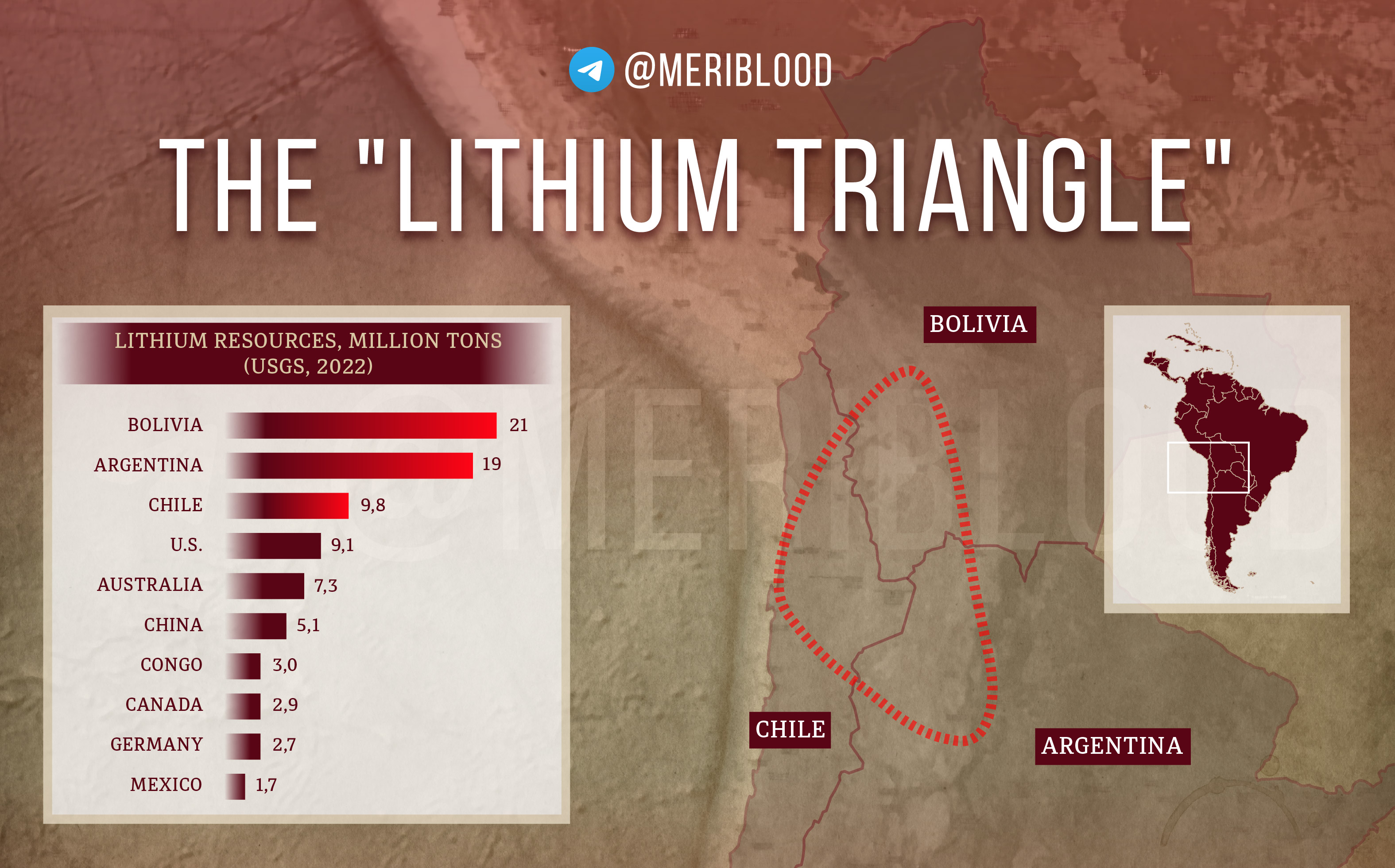
The so-called 'lithium triangle' is an arid region with expansive salt flats, shared between Chile, Argentina and Bolivia. According to estimates, this region holds 54% of the world’s lithium resources. The lithium deposits are found underneath the salt flats (contrary to Australia, which mines directly from hard rock deposits).
Bolivia is home to 21 million tons of lithium, followed by Argentina with 19.3 million and Chile with 9.6 million. These numbers are still subject to change, as active exploration leads to an increase in known resources. Identified global lithium resources rose from 53 million tons in 2018 to 89 million tons in 2022, according to the USGS.
🔻Three countries - three approaches
🇨🇱 Chile has transformed the majority of its available resources into economically viable reserves available for commercial production. Having the lowest deposits (out of the three countries), it managed to become the world’s second-largest commercial producer after Australia. The Atacama salt flat has the highest-quality, proven reserves with a low cost of production.
Things might soon change, though, as the Chilean government announced in April it will nationalize the country's lithium, requiring the state to control 51% of future ventures. Foreign lithium miners, such as Chinese SQM now must renegotiate its contract under the new rules. The Chilean Copper Commission already warns Argentina might overtake Chile as the 2nd world lithium producer by 2035, as Chile's market share is expected to decline.
🇧🇴 Bolivia has struggled to transform its lithium resources into commercially viable reserves, due in large part to the poor investment climate and the country’s political instability. The country nationalized its lithium reserves back in 2008 and missed out on foreign investment opportunities in the following decade. Having recently signed deals with China and Russia, Bolivia hopes to quickly reach high production levels in the coming years.
🇦🇷 Argentina has created a more favorable investment climate, as it asks for only 3% royalty (lower than Chile, which imposes a progressive royalty that can reach up to 40%). Since 2020, over $4 billion in investments have been announced, with dozens of private sector projects now in the pipeline. Most of these investments come from Chinese companies.
The three countries are in talks about a possible regional alliance on lithium - "a kind of lithium OPEC," as Bolivian President Luis Arce puts it.
🔻North America
🇺🇸 North America is also rich in lithium. The U.S. ranks 4th in total resources (9,1 million tons), but the only active lithium mine is in the state of Nevada, producing just 1% of global lithium.
🇲🇽 Mexico, which also holds some lithium reserves, nationalized its lithium last year and has since announced that only joint ventures with majority state control could exploit the mineral. Those companies that started lithium exploration before the nationalization process began will be able to continue mining under the previous terms.
Despite holding the largest lithium reserves, Latin American countries are lagging behind when it comes to lithium production and processing. So, which countries are actually taking advantage of the growing lithium market?
🔻🔻🔻
Part 2
#analysis #LatAm #lithium #resources #Chile #Argentina #Bolivia #US #Mexico
☠️ Blood Meridian
Forwarded from Blood Meridian
🌎 🔨LatAm in the world's race for lithium: Part 2. Production
🔻Producers
🇦🇺 Australia leads in lithium production by a wide margin, having produced 61,000 tons last year. Australia's lithium production is expected to grow at a rate of 14.2 percent and reach 116,240 tons in 2026 as mines expand. Most of the country’s lithium supply is exported to China as spodumene.
🇨🇱 Chile, the world's second largest lithium producer (39,000 tons per year), focuses not so much on the domestic processing of lithium, but rather on exporting raw materials to, primarily, South Korea, Japan, China and the EU. The recent increase in exports from Chile has predominantly been associated with lithium carbonates, which are relatively unrefined.
🇨🇳 China comes in third, producing 19,000 tons per year. While production in China is comparatively low, China imports lithium in large quantities and dominates lithium refining and battery production.
🔻China's interest
China's rapid increase in the manufacturing of goods and components means that its demand for lithium is growing at 10% a year. China has over half of the world's lithium refining capacity but has to rely on imports for about two-thirds of the raw material.
Chinese companies are now increasing their investments in the "lithium triangle." China’s Ganfeng Lithium, for example, is the majority stakeholder in Argentina’s Caucharí-Olaroz operation.
Similarly, in Chile, China’s Tianqi Lithium became the second-largest shareholder in SQM, holding 23.8 percent of shares. The Chinese companies Ganfeng Lithium and Tianqi Lithium now represent two of the top three lithium mining companies in the world.
🔻EU investments
The EU has consistently shown interest in South American lithium. In January, Scholz toured Latin America, and lithium mining was not the last thing on the agenda. At the EU-CELAC summit, EU countries announced €45bn ($49,5bn) in investments in the region, some of which are aimed at resource extraction under the guise of green initiatives.
🔻Rare earth elements industry
The US and China have split roles in the rare earth elements (REE) market and have maintained them, at least until recently. China has been developing its own resources and buying cheap raw materials from other countries, Latin America included. China has taken a large share of the REE processing market and has established production of batteries and components needed for green industries, but has not fully engaged in high-tech manufacturing.
The US and other developed countries have taken over the production of the final high-tech products of the green industry. At the same time, the US did not prevent China from increasing its presence in Latin American countries and buying cheap raw materials, as it was beneficial to both countries.
Now the REE market is changing. The US and the EU are interested in negotiating cheap raw material supplies and investing in processing facilities in Latin America, not only to reduce dependence on China but also to get their share of profits.
China is trying to develop its own high-tech manufacturing. In many areas, China will have to start from scratch because developed countries are reluctant to share the technology.
🔻"Lithium triangle" role
In this context, the "lithium triangle" countries don't care who they sell their lithium to: China, the US or the EU. Argentina, Chile and Bolivia are trying to capitalize on the growth of the lithium industry and develop domestic industrial infrastructure. However, these countries will not be able to see the same profits as the developed countries that produce the final high-tech product.
At the same time, by allowing investors into their markets, these countries give up some control. It will be easier for investors to promote their interests and dictate their terms when countries such as Bolivia, Chile and Argentina depend on resource extraction for a significant part of their budget.
🔻🔻🔻
Part 1
#analysis #LatAm #lithium #resources #Chile #Argentina #Bolivia #US #China
☠️ Blood Meridian

Forwarded from Blood Meridian
🌎 🔨LatAm in the world's race for lithium: Part 1. Resources
Chile, Argentina and Bolivia alone hold 2/3 of the world's lithium reserves. Will such an advantage help these three countries succeed in a world where demand for lithium is soaring?
🔻The 'Lithium Triangle'
The so-called 'lithium triangle' is an arid region with expansive salt flats, shared between Chile, Argentina and Bolivia. According to estimates, this region holds 54% of the world’s lithium resources. The lithium deposits are found underneath the salt flats (contrary to Australia, which mines directly from hard rock deposits).
Bolivia is home to 21 million tons of lithium, followed by Argentina with 19.3 million and Chile with 9.6 million. These numbers are still subject to change, as active exploration leads to an increase in known resources. Identified global lithium resources rose from 53 million tons in 2018 to 89 million tons in 2022, according to the USGS.
🔻Three countries - three approaches
🇨🇱 Chile has transformed the majority of its available resources into economically viable reserves available for commercial production. Having the lowest deposits (out of the three countries), it managed to become the world’s second-largest commercial producer after Australia. The Atacama salt flat has the highest-quality, proven reserves with a low cost of production.
Things might soon change, though, as the Chilean government announced in April it will nationalize the country's lithium, requiring the state to control 51% of future ventures. Foreign lithium miners, such as Chinese SQM now must renegotiate its contract under the new rules. The Chilean Copper Commission already warns Argentina might overtake Chile as the 2nd world lithium producer by 2035, as Chile's market share is expected to decline.
🇧🇴 Bolivia has struggled to transform its lithium resources into commercially viable reserves, due in large part to the poor investment climate and the country’s political instability. The country nationalized its lithium reserves back in 2008 and missed out on foreign investment opportunities in the following decade. Having recently signed deals with China and Russia, Bolivia hopes to quickly reach high production levels in the coming years.
🇦🇷 Argentina has created a more favorable investment climate, as it asks for only 3% royalty (lower than Chile, which imposes a progressive royalty that can reach up to 40%). Since 2020, over $4 billion in investments have been announced, with dozens of private sector projects now in the pipeline. Most of these investments come from Chinese companies.
The three countries are in talks about a possible regional alliance on lithium - "a kind of lithium OPEC," as Bolivian President Luis Arce puts it.
🔻North America
🇺🇸 North America is also rich in lithium. The U.S. ranks 4th in total resources (9,1 million tons), but the only active lithium mine is in the state of Nevada, producing just 1% of global lithium.
🇲🇽 Mexico, which also holds some lithium reserves, nationalized its lithium last year and has since announced that only joint ventures with majority state control could exploit the mineral. Those companies that started lithium exploration before the nationalization process began will be able to continue mining under the previous terms.
Despite holding the largest lithium reserves, Latin American countries are lagging behind when it comes to lithium production and processing. So, which countries are actually taking advantage of the growing lithium market?
🔻🔻🔻
Part 2
#analysis #LatAm #lithium #resources #Chile #Argentina #Bolivia #US #Mexico
☠️ Blood Meridian
Chile, Argentina and Bolivia alone hold 2/3 of the world's lithium reserves. Will such an advantage help these three countries succeed in a world where demand for lithium is soaring?
🔻The 'Lithium Triangle'
The so-called 'lithium triangle' is an arid region with expansive salt flats, shared between Chile, Argentina and Bolivia. According to estimates, this region holds 54% of the world’s lithium resources. The lithium deposits are found underneath the salt flats (contrary to Australia, which mines directly from hard rock deposits).
Bolivia is home to 21 million tons of lithium, followed by Argentina with 19.3 million and Chile with 9.6 million. These numbers are still subject to change, as active exploration leads to an increase in known resources. Identified global lithium resources rose from 53 million tons in 2018 to 89 million tons in 2022, according to the USGS.
🔻Three countries - three approaches
🇨🇱 Chile has transformed the majority of its available resources into economically viable reserves available for commercial production. Having the lowest deposits (out of the three countries), it managed to become the world’s second-largest commercial producer after Australia. The Atacama salt flat has the highest-quality, proven reserves with a low cost of production.
Things might soon change, though, as the Chilean government announced in April it will nationalize the country's lithium, requiring the state to control 51% of future ventures. Foreign lithium miners, such as Chinese SQM now must renegotiate its contract under the new rules. The Chilean Copper Commission already warns Argentina might overtake Chile as the 2nd world lithium producer by 2035, as Chile's market share is expected to decline.
🇧🇴 Bolivia has struggled to transform its lithium resources into commercially viable reserves, due in large part to the poor investment climate and the country’s political instability. The country nationalized its lithium reserves back in 2008 and missed out on foreign investment opportunities in the following decade. Having recently signed deals with China and Russia, Bolivia hopes to quickly reach high production levels in the coming years.
🇦🇷 Argentina has created a more favorable investment climate, as it asks for only 3% royalty (lower than Chile, which imposes a progressive royalty that can reach up to 40%). Since 2020, over $4 billion in investments have been announced, with dozens of private sector projects now in the pipeline. Most of these investments come from Chinese companies.
The three countries are in talks about a possible regional alliance on lithium - "a kind of lithium OPEC," as Bolivian President Luis Arce puts it.
🔻North America
🇺🇸 North America is also rich in lithium. The U.S. ranks 4th in total resources (9,1 million tons), but the only active lithium mine is in the state of Nevada, producing just 1% of global lithium.
🇲🇽 Mexico, which also holds some lithium reserves, nationalized its lithium last year and has since announced that only joint ventures with majority state control could exploit the mineral. Those companies that started lithium exploration before the nationalization process began will be able to continue mining under the previous terms.
Despite holding the largest lithium reserves, Latin American countries are lagging behind when it comes to lithium production and processing. So, which countries are actually taking advantage of the growing lithium market?
🔻🔻🔻
Part 2
#analysis #LatAm #lithium #resources #Chile #Argentina #Bolivia #US #Mexico
☠️ Blood Meridian
Forwarded from Blood Meridian
🌎 🔨LatAm in the world's race for lithium: Part 2. Production
🔻Producers
🇦🇺 Australia leads in lithium production by a wide margin, having produced 61,000 tons last year. Australia's lithium production is expected to grow at a rate of 14.2 percent and reach 116,240 tons in 2026 as mines expand. Most of the country’s lithium supply is exported to China as spodumene.
🇨🇱 Chile, the world's second largest lithium producer (39,000 tons per year), focuses not so much on the domestic processing of lithium, but rather on exporting raw materials to, primarily, South Korea, Japan, China and the EU. The recent increase in exports from Chile has predominantly been associated with lithium carbonates, which are relatively unrefined.
🇨🇳 China comes in third, producing 19,000 tons per year. While production in China is comparatively low, China imports lithium in large quantities and dominates lithium refining and battery production.
🔻China's interest
China's rapid increase in the manufacturing of goods and components means that its demand for lithium is growing at 10% a year. China has over half of the world's lithium refining capacity but has to rely on imports for about two-thirds of the raw material.
Chinese companies are now increasing their investments in the "lithium triangle." China’s Ganfeng Lithium, for example, is the majority stakeholder in Argentina’s Caucharí-Olaroz operation.
Similarly, in Chile, China’s Tianqi Lithium became the second-largest shareholder in SQM, holding 23.8 percent of shares. The Chinese companies Ganfeng Lithium and Tianqi Lithium now represent two of the top three lithium mining companies in the world.
🔻EU investments
The EU has consistently shown interest in South American lithium. In January, Scholz toured Latin America, and lithium mining was not the last thing on the agenda. At the EU-CELAC summit, EU countries announced €45bn ($49,5bn) in investments in the region, some of which are aimed at resource extraction under the guise of green initiatives.
🔻Rare earth elements industry
The US and China have split roles in the rare earth elements (REE) market and have maintained them, at least until recently. China has been developing its own resources and buying cheap raw materials from other countries, Latin America included. China has taken a large share of the REE processing market and has established production of batteries and components needed for green industries, but has not fully engaged in high-tech manufacturing.
The US and other developed countries have taken over the production of the final high-tech products of the green industry. At the same time, the US did not prevent China from increasing its presence in Latin American countries and buying cheap raw materials, as it was beneficial to both countries.
Now the REE market is changing. The US and the EU are interested in negotiating cheap raw material supplies and investing in processing facilities in Latin America, not only to reduce dependence on China but also to get their share of profits.
China is trying to develop its own high-tech manufacturing. In many areas, China will have to start from scratch because developed countries are reluctant to share the technology.
🔻"Lithium triangle" role
In this context, the "lithium triangle" countries don't care who they sell their lithium to: China, the US or the EU. Argentina, Chile and Bolivia are trying to capitalize on the growth of the lithium industry and develop domestic industrial infrastructure. However, these countries will not be able to see the same profits as the developed countries that produce the final high-tech product.
At the same time, by allowing investors into their markets, these countries give up some control. It will be easier for investors to promote their interests and dictate their terms when countries such as Bolivia, Chile and Argentina depend on resource extraction for a significant part of their budget.
🔻🔻🔻
Part 1
#analysis #LatAm #lithium #resources #Chile #Argentina #Bolivia #US #China
☠️ Blood Meridian
🔻Producers
🇦🇺 Australia leads in lithium production by a wide margin, having produced 61,000 tons last year. Australia's lithium production is expected to grow at a rate of 14.2 percent and reach 116,240 tons in 2026 as mines expand. Most of the country’s lithium supply is exported to China as spodumene.
🇨🇱 Chile, the world's second largest lithium producer (39,000 tons per year), focuses not so much on the domestic processing of lithium, but rather on exporting raw materials to, primarily, South Korea, Japan, China and the EU. The recent increase in exports from Chile has predominantly been associated with lithium carbonates, which are relatively unrefined.
🇨🇳 China comes in third, producing 19,000 tons per year. While production in China is comparatively low, China imports lithium in large quantities and dominates lithium refining and battery production.
🔻China's interest
China's rapid increase in the manufacturing of goods and components means that its demand for lithium is growing at 10% a year. China has over half of the world's lithium refining capacity but has to rely on imports for about two-thirds of the raw material.
Chinese companies are now increasing their investments in the "lithium triangle." China’s Ganfeng Lithium, for example, is the majority stakeholder in Argentina’s Caucharí-Olaroz operation.
Similarly, in Chile, China’s Tianqi Lithium became the second-largest shareholder in SQM, holding 23.8 percent of shares. The Chinese companies Ganfeng Lithium and Tianqi Lithium now represent two of the top three lithium mining companies in the world.
🔻EU investments
The EU has consistently shown interest in South American lithium. In January, Scholz toured Latin America, and lithium mining was not the last thing on the agenda. At the EU-CELAC summit, EU countries announced €45bn ($49,5bn) in investments in the region, some of which are aimed at resource extraction under the guise of green initiatives.
🔻Rare earth elements industry
The US and China have split roles in the rare earth elements (REE) market and have maintained them, at least until recently. China has been developing its own resources and buying cheap raw materials from other countries, Latin America included. China has taken a large share of the REE processing market and has established production of batteries and components needed for green industries, but has not fully engaged in high-tech manufacturing.
The US and other developed countries have taken over the production of the final high-tech products of the green industry. At the same time, the US did not prevent China from increasing its presence in Latin American countries and buying cheap raw materials, as it was beneficial to both countries.
Now the REE market is changing. The US and the EU are interested in negotiating cheap raw material supplies and investing in processing facilities in Latin America, not only to reduce dependence on China but also to get their share of profits.
China is trying to develop its own high-tech manufacturing. In many areas, China will have to start from scratch because developed countries are reluctant to share the technology.
🔻"Lithium triangle" role
In this context, the "lithium triangle" countries don't care who they sell their lithium to: China, the US or the EU. Argentina, Chile and Bolivia are trying to capitalize on the growth of the lithium industry and develop domestic industrial infrastructure. However, these countries will not be able to see the same profits as the developed countries that produce the final high-tech product.
At the same time, by allowing investors into their markets, these countries give up some control. It will be easier for investors to promote their interests and dictate their terms when countries such as Bolivia, Chile and Argentina depend on resource extraction for a significant part of their budget.
🔻🔻🔻
Part 1
#analysis #LatAm #lithium #resources #Chile #Argentina #Bolivia #US #China
☠️ Blood Meridian