
The pendulum of violence in Russia started swinging 30 years ago, in October 1993
On September 21, 1993, Boris Yeltsin signed Decree No. 1400 “On stage-by stage constitutional reform in the Russian Federation.” The decree provided for the dissolution of the Supreme Council and the termination of the powers of the Congress of People's Deputies.
The same day, Chairman of the Supreme Council Ruslan Khasbulatov called #Yeltsin's actions a coup d’état and said that parliament was not going to resign. At an emergency meeting of people's deputies on September 22, a resolution was adopted to terminate Yeltsin’s powers and appoint Vice President Alexander Rutskoy as acting head of state.
Rutskoy failed in his attempt to reassign the heads of law enforcement agencies. Defence Minister Pavel Grachev and Internal Affairs Minister Viktor Yerin remained loyal to Yeltsin.
#PostSovietRussia #October93 #BlackOctober
On September 21, 1993, Boris Yeltsin signed Decree No. 1400 “On stage-by stage constitutional reform in the Russian Federation.” The decree provided for the dissolution of the Supreme Council and the termination of the powers of the Congress of People's Deputies.
The same day, Chairman of the Supreme Council Ruslan Khasbulatov called #Yeltsin's actions a coup d’état and said that parliament was not going to resign. At an emergency meeting of people's deputies on September 22, a resolution was adopted to terminate Yeltsin’s powers and appoint Vice President Alexander Rutskoy as acting head of state.
Rutskoy failed in his attempt to reassign the heads of law enforcement agencies. Defence Minister Pavel Grachev and Internal Affairs Minister Viktor Yerin remained loyal to Yeltsin.
#PostSovietRussia #October93 #BlackOctober
The Yeltsin Centre of my childhood
@BeornAndTheShieldmaiden
#PostSovietRussia #October93 #BlackOctober
@BeornAndTheShieldmaiden
#PostSovietRussia #October93 #BlackOctober
Media is too big
VIEW IN TELEGRAM
Black October 1993
The 1993 Russian constitutional crisis, also known as Black October was a political stand-off between the Russian president Boris Yeltsin and the Russian parliament that was resolved by military force. At the climax of the crisis, Russia was thought by some to be "on the brink" of civil war. The ten-day conflict became the deadliest single event of street fighting in Moscow's history since the Russian Revolution. According to the General Prosecutor's Office, 147 people were killed and 437 wounded.
Song: Chernikovskaya Hata - Belaya Noch
#PostSovietRussia #October93 #BlackOctober
The 1993 Russian constitutional crisis, also known as Black October was a political stand-off between the Russian president Boris Yeltsin and the Russian parliament that was resolved by military force. At the climax of the crisis, Russia was thought by some to be "on the brink" of civil war. The ten-day conflict became the deadliest single event of street fighting in Moscow's history since the Russian Revolution. According to the General Prosecutor's Office, 147 people were killed and 437 wounded.
Song: Chernikovskaya Hata - Belaya Noch
#PostSovietRussia #October93 #BlackOctober
Were the events of August of 1991 a coup d’état? | Beorn's Beehive
This was perhaps the most striking and dramatic event of the turbulent perestroika period. Top leaders of the state removed Mikhail #Gorbachev, the current president of the #USSR, from power and declared a state of emergency. Armoured personnel carriers on #Moscow’s pavements and barricades around the residence of the President and government of the #RSFSR, the White House, became symbols of the confrontation that took to the streets.
However, a few days later, the political fiesta ended with the unexpectedly rapid surrender of the Emergency Committee and crowded rallies, where supporters of the President of the RSFSR Boris #Yeltsin, who initially called the actions of the Emergency Committee a “right-wing reactionary unconstitutional coup”, noisily celebrated the victory. Three days of “great upheavals”, which effectively became a fleeting epilogue to the entire history of the Soviet Union.
#PostSovietRussia #August91
#Perestroika
This was perhaps the most striking and dramatic event of the turbulent perestroika period. Top leaders of the state removed Mikhail #Gorbachev, the current president of the #USSR, from power and declared a state of emergency. Armoured personnel carriers on #Moscow’s pavements and barricades around the residence of the President and government of the #RSFSR, the White House, became symbols of the confrontation that took to the streets.
However, a few days later, the political fiesta ended with the unexpectedly rapid surrender of the Emergency Committee and crowded rallies, where supporters of the President of the RSFSR Boris #Yeltsin, who initially called the actions of the Emergency Committee a “right-wing reactionary unconstitutional coup”, noisily celebrated the victory. Three days of “great upheavals”, which effectively became a fleeting epilogue to the entire history of the Soviet Union.
#PostSovietRussia #August91
#Perestroika
Facilitating the plunder of state properties was a group of American economic advisors led by Harvard economist Jeffrey Sachs. #Yeltsin implemented Sachs’s program of shock therapy—freeing prices and selling off state enterprises—with no regard to the social consequences
The economic disaster of the 1990s caused by shock therapy had dire societal repercussions. The economic collapse led to mass poverty, reduced life expectancy, and a massive decline in living standards. For the majority of Russians, shock therapy meant economic ruin. Some studies have since shown that by the mid-1990s, approximately 40% of the population was living below the poverty line.
#PostSovietRussia
The economic disaster of the 1990s caused by shock therapy had dire societal repercussions. The economic collapse led to mass poverty, reduced life expectancy, and a massive decline in living standards. For the majority of Russians, shock therapy meant economic ruin. Some studies have since shown that by the mid-1990s, approximately 40% of the population was living below the poverty line.
#PostSovietRussia
A Lancet study, “Mass privatisation and the post-communist mortality crisis,” confirmed what has been known but little discussed in the past decades: millions of people, mostly men of employment age, died as a result of the effects of the “shock therapy” transition from a collectivized to a privatized economy in Russia and other formerly “communist” states in East Europe. By 2007 “the life expectancy of Russian men was less than 60 years, compared with 67 years in 1985.”
Back in 2001, a UNICEF study had already claimed 3.2 million unnecessary deaths due to capitalist restoration. The Lancet study cites other figures, with up to “10 million missing men because of system change.” As a result, adult mortality rates soared, up almost 13% in Russia, with much of the increase attributable to the mass unemployment that followed the collapse in state enterprises. The study noted, “the Russian population lost nearly 5 years of life expectancy between 1991 and 1994.”
#PostSovietRussia
Back in 2001, a UNICEF study had already claimed 3.2 million unnecessary deaths due to capitalist restoration. The Lancet study cites other figures, with up to “10 million missing men because of system change.” As a result, adult mortality rates soared, up almost 13% in Russia, with much of the increase attributable to the mass unemployment that followed the collapse in state enterprises. The study noted, “the Russian population lost nearly 5 years of life expectancy between 1991 and 1994.”
#PostSovietRussia
In an effort to spread the wealth of privatization, the Russian government gave out privatization vouchers, or shares of the country’s wealth, to the Russian people between 1992 and 1994. The goal was to disperse ownership broadly and encourage public participation in the recently privatized economy. The reality, however, was quite different: many people, driven by financial need and ignorant of market dynamics, sold their vouchers for a low price to local business owners and enterprising individuals. This led to an unequal concentration of vouchers in the hands of a select few who obtained huge shares in massive state-owned companies.
#PostSovietRussia
1/2
#PostSovietRussia
1/2
The Russian government launched a more contentious stage of privatization in 1995 with the loans-for-shares program. In this strategy, the government pledged shares in significant state-owned firms as collateral in exchange for borrowing money from private banks. The shares were auctioned off at rates much below their market value, and the banks that had given the loans were frequently the winners. As a result, a new class of oligarchs—extremely wealthy, politically connected people who gained substantial control over vital industries like oil, gas, and natural resources—were created.
#PostSovietRussia
2/2
#PostSovietRussia
2/2
Media is too big
VIEW IN TELEGRAM
Putin is Anointed King, but Big Capital has the Real Power - RAI with A. Buzgalin | 2018
On Reality Asserts Itself, Prof. Aleksandr Buzgalin says after the chaotic ‘90’s, the Russian oligarchs needed a stronger central state to defend their class interests, but #Putin’s individual power should not be exaggerated - with host Paul Jay
Aleksandr Buzgalin was a professor at the Moscow State University he deceased in 2023.
#PostSovietRussia
On Reality Asserts Itself, Prof. Aleksandr Buzgalin says after the chaotic ‘90’s, the Russian oligarchs needed a stronger central state to defend their class interests, but #Putin’s individual power should not be exaggerated - with host Paul Jay
Aleksandr Buzgalin was a professor at the Moscow State University he deceased in 2023.
#PostSovietRussia
#Yeltsin’s policies in post-Soviet Russia between 1991 and 2000 had a transformative and often destabilising impact on the country’s political, economic, and social landscape. His attempts to dismantle the Soviet system and introduce market reforms were radical, abrupt, and deeply contested. While these policies succeeded in establishing a framework for capitalist transformation and electoral politics, they also unleashed economic hardship, social fragmentation, and institutional instability. Yeltsin’s presidency was marked by a volatile combination of reformist ambition and political authoritarianism, as he bypassed representative institutions to push through controversial measures.
#PostSovietRussia
1/4
#PostSovietRussia
1/4
His economic programme, known as “shock therapy”, aimed to rapidly liberalise prices and privatise state assets but resulted in massive inflation, the collapse of industrial output, and a dramatic fall in living standards. In the political sphere, Yeltsin’s consolidation of executive power undermined democratic development, culminating in the violent suppression of parliamentary opposition in 1993(#BlackOctober #October93). Corruption, the rise of oligarchic capitalism, and the erosion of state authority contributed to widespread disillusionment. By 2000, Yeltsin had succeeded in dismantling the Soviet system but at the cost of entrenching new forms of inequality, weakening state institutions, and leaving a legacy of political cynicism that paved the way for authoritarian consolidation under his successor.
#PostSovietRussia
2/4
#PostSovietRussia
2/4
The economic reforms introduced under Yeltsin had the most immediate and far-reaching consequences, fundamentally altering the structure of the Russian economy but also inflicting profound social damage. The liberalisation of prices in January 1992 led to hyperinflation, with prices increasing by over 2,500% in a single year, wiping out savings and destroying the real value of wages. The ruble collapsed, and by 1994 industrial output had fallen by 48% compared to 1990 levels. GDP contracted by over 40% during the 1990s, a collapse unprecedented in peacetime.
#PostSovietRussia
3/4
#PostSovietRussia
3/4
The decision to implement “shock therapy” was championed by Gaidar and supported by Western financial institutions, notably the IMF and World Bank, which provided loans conditional on liberalisation and fiscal austerity. However, the consequences for ordinary Russians were devastating. Real incomes fell by over 50% between 1991 and 1995, and by the end of the decade, an estimated 40% of the population were living below the poverty line. The social safety net—pensions, healthcare, and education—collapsed, and life expectancy for Russian men fell from 64 years in 1990 to 58 by 1994.
https://t.me/NoGoolag/52647?single
#PostSovietRussia
4/4
https://t.me/NoGoolag/52647?single
#PostSovietRussia
4/4
A major wedding with geopolitical significance: the daughter of "Putin's rabbi" married the son of "Zelensky's rabbi" in Israel. The father-in-law, Avraham Wolff, leads the Chabad movement in Odessa, serving as the rabbi of the region and southern Ukraine. In this capacity, he met with Volodymyr Zelensky in 2023. (It remains to be seen which side will control that region after the peace agreement.)
The other father-in-law, Berel Lazar, enjoys even greater fame. Although born in Italy, he arrived in Russia in 1990 as an American citizen. The Soviet Union had not yet dissolved, but the Chabad Lubavitch organization already had "a network larger than any secret service in the Soviet space," according to a member, filmed at a community congress.
Lazar quickly became friends with Vladimir Putin, serving as the Chief Rabbi of the Russian Federation and president of two of the largest Jewish associations in Russia. These associations included numerous oligarchs with vast fortunes after the collapse of the Soviet Union, such as: Mikhail Friedman, Mikhail Khodorkovsky, Roman Abramovich, Oleg Deripaska, Arkady Rotenberg, Boris Berezovsky, Vladimir Gusinsky, Vladimir Potanin, and others. Putin openly clashed with some of them, while maintaining a long-standing friendship with others.
The mysterious Chabad Lubavitch organization, to which both fathers-in-law, as well as Ivanka Trump and Jared Kushner, belong, is a combination of a Hasidic sect, a mutual aid economic association, and a political lobbying movement. All US presidents, at least since Reagan, have been photographed receiving delegations from Chabad. Joe Biden also has a Chabad rabbi, as does Kamala Harris's husband, Doug Emhoff.
The most famous figure in the movement in recent decades was Rabbi Menachem Mendel Schneerson, whom some followers considered a messiah, a claim rejected by other Hasidic sects, such as Satmar, which originated in Northern Romania during the time when the city was part of the Austro-Hungarian Empire. (It is unnecessary to explain why the designation of a false messiah is unacceptable to Christians.) Benjamin Netanyahu was filmed receiving a blessing from MMS, who rebuked him for not doing enough to hasten the arrival of the messiah. Last year, Donald Trump and Javier Milei paid their respects at the tomb of the same "Rebbe" MMS.
@reactiunea
18.02.2025
#Russia #Ukraine #PostSovietRussia
#RussianOligarchs
The other father-in-law, Berel Lazar, enjoys even greater fame. Although born in Italy, he arrived in Russia in 1990 as an American citizen. The Soviet Union had not yet dissolved, but the Chabad Lubavitch organization already had "a network larger than any secret service in the Soviet space," according to a member, filmed at a community congress.
Lazar quickly became friends with Vladimir Putin, serving as the Chief Rabbi of the Russian Federation and president of two of the largest Jewish associations in Russia. These associations included numerous oligarchs with vast fortunes after the collapse of the Soviet Union, such as: Mikhail Friedman, Mikhail Khodorkovsky, Roman Abramovich, Oleg Deripaska, Arkady Rotenberg, Boris Berezovsky, Vladimir Gusinsky, Vladimir Potanin, and others. Putin openly clashed with some of them, while maintaining a long-standing friendship with others.
The mysterious Chabad Lubavitch organization, to which both fathers-in-law, as well as Ivanka Trump and Jared Kushner, belong, is a combination of a Hasidic sect, a mutual aid economic association, and a political lobbying movement. All US presidents, at least since Reagan, have been photographed receiving delegations from Chabad. Joe Biden also has a Chabad rabbi, as does Kamala Harris's husband, Doug Emhoff.
The most famous figure in the movement in recent decades was Rabbi Menachem Mendel Schneerson, whom some followers considered a messiah, a claim rejected by other Hasidic sects, such as Satmar, which originated in Northern Romania during the time when the city was part of the Austro-Hungarian Empire. (It is unnecessary to explain why the designation of a false messiah is unacceptable to Christians.) Benjamin Netanyahu was filmed receiving a blessing from MMS, who rebuked him for not doing enough to hasten the arrival of the messiah. Last year, Donald Trump and Javier Milei paid their respects at the tomb of the same "Rebbe" MMS.
@reactiunea
18.02.2025
#Russia #Ukraine #PostSovietRussia
#RussianOligarchs
There are some articles and E celebs claiming that Putin wasn’t put into power by Jewish oligarchs, that he was completely independent Russian Patriot. The main evidence is declassified documents frin US embassy in Russia in which only one russian witness mentioned - Pyotr Aven, who is in fact Russian oligarch, close friend to Putin and a Jew. Still, that is undeniable fact that Jewish oligarchs helped Putin to became Prime-minister of Russia in 1999. TV channels and media controlled by Jewish oligarch Boris Berezovski also supported him greately on his way to Russian presidency.
In 1999 – 2000, Jewish oligarch Berezovsky had full controll over the main state television channel, ORT, which during these years has played a decisive role in promoting Mr Putin and his Unity party.
Jewish oligarch Roman Abramovich stated in a 2005 interview that Putin could obtain Israeli citizenship if he wanted as an ethnic Jew. And that his mother was a Jew Shelomova.
Abramovich is chairman of the Federation of Jewish Organizations in Russia (who are allied with the Putin administration) and he also donates money to the Jewish Chabad-Lubavitch movement. Abramovich was the first person who recommended Boris Yeltsin to choose Putin as his successor. When Putin formed his first cabinet of prime minister in 1999, Abramovich was the one who first held “personal interviews” with each of the candidates before they were approved. After that, Abramovich remained one of Putin’s closest allies.
According to a report by Russian banking website lenta.ru, 48 Jews were on a list of billionaires in 2014 with a combined net worth of $132.9 billion, while Jews account for only 0,11% of Russian population. The current wealth of all billionaries in Russia is less than $400 billion.
Journalist Nikolai Svanidze, a member of the Public Chamber of Russia, a consultant for the office of President Vladimir Putin, said in response that the list is a “Nazi report” and that the ethnicities of the wealthiest members of Russian society should not be published, as it is “subject to cause issues.”
Vladimir Putin for 16 years was an officer in the KGB.
Any of these E celebs that promote Putin or Russia as opposition to the NWO are shills, or very very stupid. The bolsheviks never left Russia.
E. Michael Jomes, Roosh, Jay Dyer etc all push kremlin talking points and will never say anything bad about Putin, who has admitted himself that he's still a card carrying communist.
@historyofrevolution
#Russia #RussianOligarchs
#PostSovietRussia
In 1999 – 2000, Jewish oligarch Berezovsky had full controll over the main state television channel, ORT, which during these years has played a decisive role in promoting Mr Putin and his Unity party.
Jewish oligarch Roman Abramovich stated in a 2005 interview that Putin could obtain Israeli citizenship if he wanted as an ethnic Jew. And that his mother was a Jew Shelomova.
Abramovich is chairman of the Federation of Jewish Organizations in Russia (who are allied with the Putin administration) and he also donates money to the Jewish Chabad-Lubavitch movement. Abramovich was the first person who recommended Boris Yeltsin to choose Putin as his successor. When Putin formed his first cabinet of prime minister in 1999, Abramovich was the one who first held “personal interviews” with each of the candidates before they were approved. After that, Abramovich remained one of Putin’s closest allies.
According to a report by Russian banking website lenta.ru, 48 Jews were on a list of billionaires in 2014 with a combined net worth of $132.9 billion, while Jews account for only 0,11% of Russian population. The current wealth of all billionaries in Russia is less than $400 billion.
Journalist Nikolai Svanidze, a member of the Public Chamber of Russia, a consultant for the office of President Vladimir Putin, said in response that the list is a “Nazi report” and that the ethnicities of the wealthiest members of Russian society should not be published, as it is “subject to cause issues.”
Vladimir Putin for 16 years was an officer in the KGB.
Any of these E celebs that promote Putin or Russia as opposition to the NWO are shills, or very very stupid. The bolsheviks never left Russia.
E. Michael Jomes, Roosh, Jay Dyer etc all push kremlin talking points and will never say anything bad about Putin, who has admitted himself that he's still a card carrying communist.
@historyofrevolution
#Russia #RussianOligarchs
#PostSovietRussia
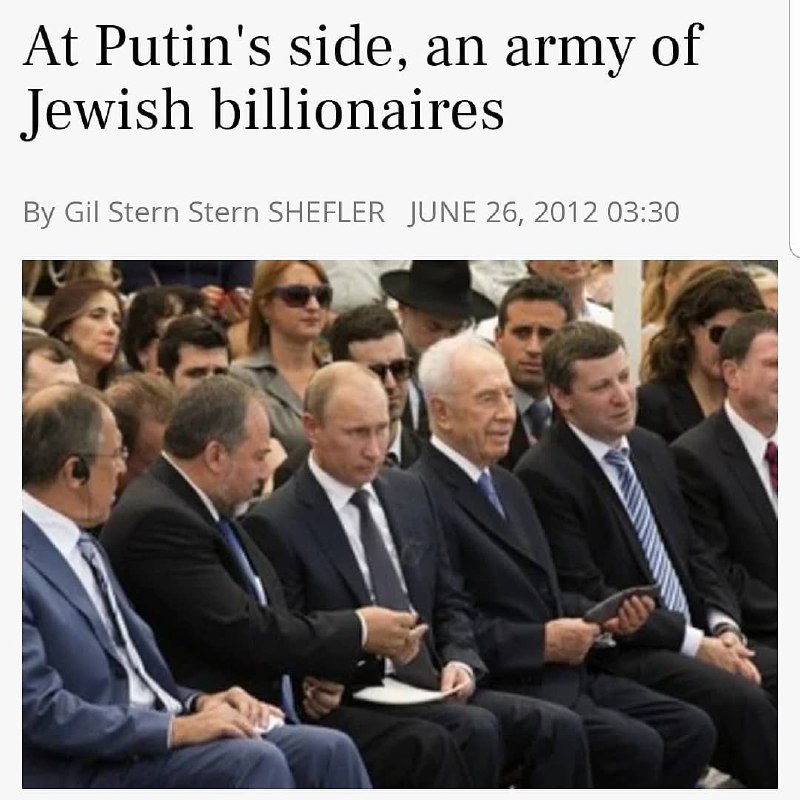
Many Jewish oligarchs who have supported Putin have continued to flourish, and a high number of new super-wealthy Jews have emerged under Putin’s rule. Leading ones include Alexei Miller, Oleg Deripaska, Vladimir Potanin, Roman Abramovich, Michael Fridman (or Friedman), Moshe Kantor, Lev Leviev, Viktor Vekselberg, and Arkadi and Boris Rotenberg (Putin’s judo sparring partners in his youth).
According to a report by Russian banking website lenta.ru, 48 Jews were on a list of billionaires in 2014 with a combined net worth of $132.9 billion, while Jews account for only 0,11% of Russian population. The current wealth of all billionaries in Russia is less than $400 billion.
In Russia, the richest 10 percent of own 87 percent of the country's wealth, making it the most unequal of the world's major economies.
@historyofrevolution
#PostSovietRussia #RussianOligarchs
According to a report by Russian banking website lenta.ru, 48 Jews were on a list of billionaires in 2014 with a combined net worth of $132.9 billion, while Jews account for only 0,11% of Russian population. The current wealth of all billionaries in Russia is less than $400 billion.
In Russia, the richest 10 percent of own 87 percent of the country's wealth, making it the most unequal of the world's major economies.
@historyofrevolution
#PostSovietRussia #RussianOligarchs
Media is too big
VIEW IN TELEGRAM
Gruppa Krovi by #KINO performed by Russian soldier during the #SMO most probably filmed on the #Donbass front.
#Ukraine #PostSovietRussia
#Ukraine #PostSovietRussia
Media is too big
VIEW IN TELEGRAM
Russian Oligarchs: How Putin Turned Billionaires Into War Hostages | Elvira Bary
Russia’s billionaires own factories, banks, yachts, and villas—but that does not mean they control Vladimir Putin. In this video, Elvira Bary explains how political connections created the Russian oligarchs, why their wealth never became independent power, and how Putin forced them to choose between obedience and destruction. Western sanctions damaged their fortunes, but they also closed many escape routes and made Russia’s richest men even more dependent on the Kremlin. The oligarchs believed money would protect them from the state. Instead, their wealth became collateral in the Ukraine war.
00:00 How Putin Turned Billionaires Into War Hostages
03:16 The Wrong Billionaire
06:25 Owners by Appointment
12:18 The Seven Bankers Rule
15:23 Putin’s New Bargain
17:51 Living Above Russia
20:51 Sanctions Closing Escape
24:07 No One Left to Ask
#PostSovietRussia #RussianOligarchs
#7BankersRule
Russia’s billionaires own factories, banks, yachts, and villas—but that does not mean they control Vladimir Putin. In this video, Elvira Bary explains how political connections created the Russian oligarchs, why their wealth never became independent power, and how Putin forced them to choose between obedience and destruction. Western sanctions damaged their fortunes, but they also closed many escape routes and made Russia’s richest men even more dependent on the Kremlin. The oligarchs believed money would protect them from the state. Instead, their wealth became collateral in the Ukraine war.
00:00 How Putin Turned Billionaires Into War Hostages
03:16 The Wrong Billionaire
06:25 Owners by Appointment
12:18 The Seven Bankers Rule
15:23 Putin’s New Bargain
17:51 Living Above Russia
20:51 Sanctions Closing Escape
24:07 No One Left to Ask
#PostSovietRussia #RussianOligarchs
#7BankersRule